English



The Leu-Euro Exchange Rate is No Longer "Frozen” as in 2023-2024, But Nor Does It Freely Reflect the Imbalances of the Economy.
In January 2026, the Euro Crossed the 5.08-5.09 Lei Threshold, After a Slow, Managed Depreciation, and the NBR's Key Interest Rate Dropped to 6.5%.
The Message Is Clear: Romania Has Started a Transition, But Without Changing Its Fundamental Strategy. The Adjustment Is There, But It Is Carefully Measured, To Avoid Social and Political Shocks.
The Relative Stability of the Exchange Rate Is Not the Result of a Balanced Economy, But of a Policy Mix That Shifts Pressure from the Exchange Rate to the Cost of Money. Interest Rates Remain High, State Financing Is Expensive, and Economic Growth Remains Modest. In Other Words, the Leu is Stable Because It Is Defended, Not Because the Economy Would Naturally Support It.
• Interest remains the main shock absorber
The 6.5% key interest rate continues to place Romania among the economies with the most restrictive monetary policy in the region.
The differential with the euro area continues to act as a shield: it discourages capital outflows and maintains interest in lei-denominated assets.
However, the price is evident in the economy: expensive loans, postponed investments, high yields required by the state to finance its deficits.
The higher exchange rate than in previous years shows that the pressures have not disappeared. They have been allowed to manifest themselves partially, at a controlled pace. We are not talking about a rigid defense, but about prudent management of the slide, which is trying to buy time.
• Smaller deficits, but still problematic
The trade deficit remains large, even if the growth rate has moderated. Exports have started to recover, imports have slowed down, and fiscal consolidation has become inevitable. However, the underlying imbalance persists. The fact that the leu did not depreciate further does not mean that the problem has been solved, but that it is compensated by internal costs: high interest rates and weak economic growth.
• What other options could there have been?
The chosen strategy was not the only possible one. Romania had - and still has - alternatives. The differences between them depend on who pays the cost and when.
1) Adjustment through exchange rate, not interest rate (the avoided option)
Instead of defending the currency with high interest rates, the authorities could have allowed a clearer and faster depreciation of the leu.
What would have meant:
- an exchange rate perhaps at 5.10-5.30 lei/euro (a level at which the economy is already partially at);
- more expensive imports and tempering debt-driven consumption;
- more competitive exports and domestic production;
- room for lower interest rates.
The cost: short-term inflation, social discontent, loss of political capital.
The benefit: adjusting imbalances through prices, not by stifling credit; an economy less dependent on the "interest shield”.
This would have been the painful option immediately, but healthier in the medium term.
2) Real fiscal and trade correction (the economically correct option, but politically difficult)
The second option would have been to reduce the pressure on the leu at the source.
What it would have entailed:
- real, not cosmetic, budgetary discipline;
- reducing waste and rigid spending;
- policies for domestic production, not just consumption;
- using European funds for productive investments, not temporary compensations.
The cost: political conflicts, unpopular reforms, slower growth in the short term.
The benefit: lasting stability, a naturally supported exchange rate, without punitive interest rates.
This is the good option, but almost never chosen on time.
• Why was none of the optimal options chosen?
Because both hit immediately and visibly:
- either in the standard of living (through the exchange rate),
- or in the political and budgetary structures (through reforms).
The current strategy - high interest rates and a relatively stable exchange rate - postpones the cost, makes it less visible and distributes it diffusely: through expensive loans, failed investments and weak economic growth. It is the most convenient political option, not the most economically efficient.
• Comparative matrix of options
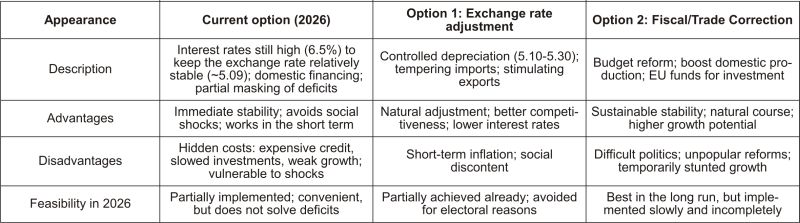
The alternative was and still is: either let the exchange rate adjust the economy, or fix the economy so that the exchange rate is no longer forced. Romania chose a third way: to keep the exchange rate under control and let interest rates do all the hard work.
It works in the short term.
In the long term, however, this choice makes the stability of the leu expensive, fragile, and permanently conditional.
























 Euro
Euro Dolar SUA
 Franc elveţian
 Liră sterlină
 Gram de aur