English

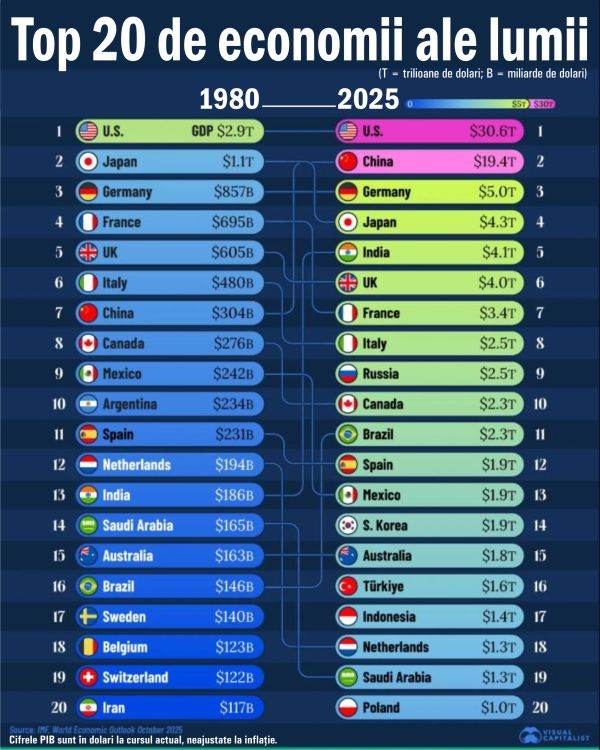
The global economic landscape has undergone a major transformation in the past four decades. While some countries have maintained their dominance, others have emerged from relative obscurity to become among the world's largest economies, according to an analysis by visualcapitalist.com, which compares the world's major economies from 1980 to 2025, based on data from the International Monetary Fund (IMF). The Gross Domestic Product (GDP) of the countries in the ranking is calculated in US dollars - current exchange rates, not adjusted for inflation.
• The United States remains at the top of the ranking
Ranked in first place in 1980, with a nominal GDP of $2.857 trillion, the United States of America still holds global supremacy in 2025, with $30.616 trillion.
The continued dominance of the US reflects a combination of factors, including technological leadership, mature capital markets, robust consumer demand and the global role of the US dollar.
• China's historic rise
China has seen the most significant momentum in the rankings. In 1980, the Asian country ranked well outside the world's top five economies, with a GDP of just over $300 billion. In 2010, China overtook Japan to become the world's second-largest economy, and by 2025 its GDP is expected to reach nearly $19.4 trillion. This growth has been driven by rapid industrialization, export-led economic expansion, urbanization and large-scale infrastructure investment.
• Japan plateaus, Europe stabilizes
Japan was the world's second-largest economy for much of the 1980s and 1990s, peaking in the mid-1990s. In 1980, it was second, with $1.129 trillion, for example. However, slower economic growth and demographic challenges have seen the country slip to fourth place in 2025, with a GDP of $4.28 trillion.
Meanwhile, major European economies such as Germany, the United Kingdom and France have remained consistently near the top of the rankings. Although their growth has been slower than that of China, these countries continue to play an important role in global trade and finance, the source notes.
Germany was third in the top 10 in 1980, with a GDP of $857 billion, and in 2025 it will be in the same position, with $5.014 trillion. The United Kingdom had a GDP of $605 billion in 1980 (5th in the world), and in 2025 - $3.959 trillion (6th). France, with a GDP of $695 billion, was fourth in 1980, and in 2025, with a GDP of $3.362 trillion, it was seventh.
• Emerging markets on the rise
Beyond China, several emerging markets have climbed the rankings over time. India has steadily climbed, entering the top five in 2025, with a GDP of $4.125 trillion, while countries such as Indonesia, Turkey and Saudi Arabia have gained importance as their economies have expanded and diversified.
At the same time, some economies that ranked at the top in 1980 - such as Italy and Argentina - have lost ground over time.
• Global GDP of $123.6 trillion in 2026
The global economy is estimated to reach $123.6 trillion in 2026, as countries recover from recent shocks and adjust to high interest rates.
According to the IMF, the United States maintains its position as the world's largest economy this year, with an estimated GDP of $31.8 trillion, more than the next two countries combined. The U.S. economy has grown by about 70% over the past 25 years, in inflation-adjusted terms.
China ranks second, at $20.7 trillion, reflecting slower but still substantial growth as it moves toward advanced manufacturing.
In Europe, Germany ($5.328 trillion) remains the largest economy, with the United Kingdom ($4.266 trillion), France ($3.559 trillion), and Italy ($2.702 trillion) all among the world's top ten economies. These countries are also among the world's richest economies by GDP per capita.
Many emerging markets continue to gain economic weight in 2026. India's economy is projected to reach $4.5 trillion, making it the world's fourth-largest economy by GDP.


























 Euro
Euro Dolar SUA
 Franc elveţian
 Liră sterlină
 Gram de aur