English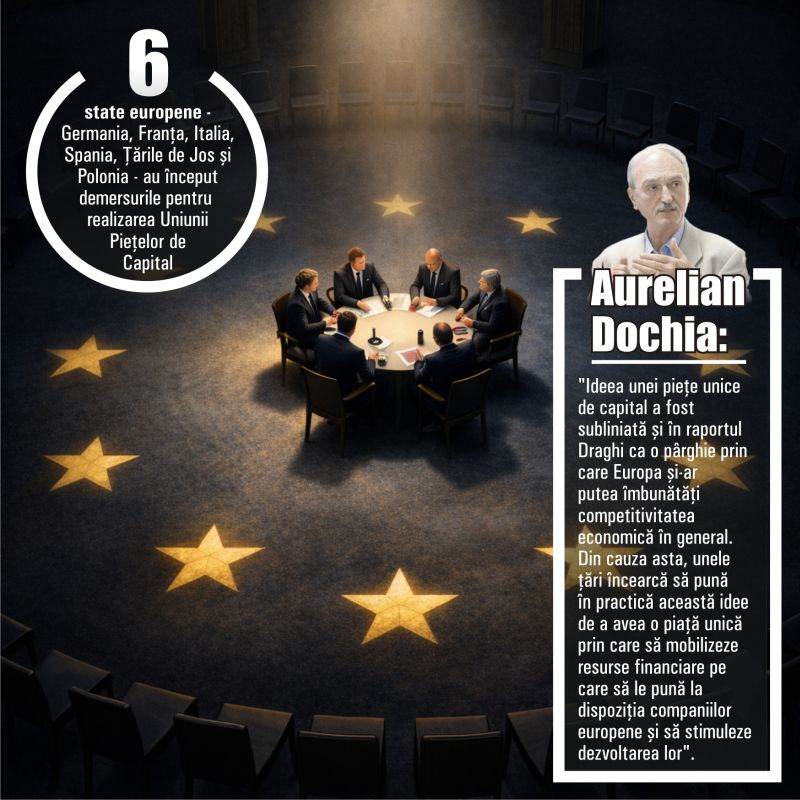
Six European countries - Germany, France, Italy, Spain, the Netherlands and Poland - have begun the process of creating the Capital Markets Union, an initiative that would divide the EU in two on this issue, meaning that we will have a two-speed Union to regain lost ground in global economic competition, an idea that gained traction following the informal meeting of the European Council held last Thursday in Belgium. Following recent discussions in Brussels, the concept of a "two-speed Europe" is no longer a marginal idea, but an openly stated strategic option: if unanimity slows down essential reforms, a core of states will advance through strengthened cooperation. This change in tone is significant. The European Union was built on consensus, and unanimity was the guarantee of balance between states. However, consensus has become, in the current context, synonymous with slowness, and slowness with vulnerability. Europe is simultaneously facing economic, technological and geopolitical pressures, in a world where the US and China act quickly, aggressively and in a coordinated manner. In this context, the idea of a differentiated integration appears, for more and more European leaders, not as a deviation from unity, but as a condition for the survival of the European project.
Therefore, the debate about a "two-speed Europe” is no longer a theoretical speculation, but is taking institutional shape with the emergence of the E6 format, an informal initiative led by the Franco-German tandem and composed of the six largest economies of the Union: Germany, France, Italy, Spain, the Netherlands and Poland.
• Kyriakos Pierrakakis: E6, a temporary initiative
Eurogroup President Kyriakos Pierrakakis recently stated, as quoted by Euractiv, that this nucleus would represent a "temporary initiative” intended to accelerate convergence on priorities already discussed at EU level, a message presented as reassuring, although the political reality behind this formula raises uncomfortable questions about the balance of power, sovereignty and the future of the Capital Markets Union. Pierrakakis insisted that German Vice Chancellor Lars Klingbeil had offered assurances regarding the transparency and non-competitive nature of the E6 compared to established formats, such as the Eurogroup or Ecofin, but European leaders Ursula von der Leyen and Emmanuel Macron have brought back the scenario of differentiated integration, explicitly suggesting that the lack of progress at EU-27 level could push Europe towards a double speed of economic and financial integration.
At the heart of this dynamic is the European capital market, an old but incomplete project that aims to unify investment flows, reduce financial fragmentation and give companies easier access to cross-border financing. Supporters of the E6 talk about efficiency, speed and the ability of the big economies to act as "pacemakers” of European competitiveness, according to French Finance Minister Roland Lescure, quoted by Euractiv, who also said that Europe must not only move well, but also faster. The logic seems seductive: if decisions in 27 states are blocked by divergent interests, then the strongest economies can pave the way. But this selective acceleration hides a subtle but profound structural change: the real center of negotiation is moving to a small, informal circle, in which critical economic mass becomes the dominant criterion, and the broad European consensus risks being replaced by a pre-coordination of the big players.
From the perspective of capital market integration, the implications are major. A Single Capital Market built through informal mechanisms of the E6 could produce standards, rules and priorities initially defined by this core, then exported to the rest of the Union as a starting point, not as a result of collective bargaining. In theory, smaller states would benefit from accelerated harmonisation; in practice, they could find themselves in a position to validate or reject packages already calibrated according to the interests of the dominant economies.
• Capital Markets Union, needed to finance the green transition, digitalisation, rearmament
According to Euractiv, the criticism expressed by Simon Harris, the Irish finance minister, reflects exactly this anxiety: the preference for thematic coalitions, built on shared visions, not on the exclusive criterion of economic size. His message is one of diplomatic warning, but clear: clubs based on size can erode trust and internal solidarity.
In parallel with the optimistic official discourse, critical voices go much further, describing E6 as a step towards de facto centralization, achieved through the phrase "fait accompli.” In an analysis published by Brussels Signals, Marcin Romanowski, former Deputy Minister of Justice in Poland, outlines a radically different narrative: E6 not as an instrument t ethnocratic efficiency, but as an extra-treaty mechanism through which Germany and France consolidate their dominance over the Union's strategic directions, from energy and defense to finance and critical raw materials. In this interpretation, the accelerated integration of capital markets is not a neutral goal, but a vector for deepening fiscal integration, pressure on the adoption of the euro and the progressive diminution of national states' veto rights.
This tension between efficiency and legitimacy becomes essential for the future single capital market. On the one hand, Europe urgently needs deeper and more liquid capital markets to finance the green transition, digitalization, rearmament and strategic autonomy. On the other hand, if the process is perceived as being captured by a narrow core, the political risk increases exponentially: resistance from excluded states, challenges to the fairness of the rules and a polarization between "center” and "periphery”. Instead of reducing fragmentation, a two-speed Europe in the financial field could reconfigure it along other fault lines.
Critics also ask whether differentiated integration can accelerate progress without eroding political cohesion, given that the recent history of the eurozone shows that different speeds produce both convergences and divergences. Applied to capital markets, this logic could generate a "financial core” with rapidly harmonized rules, while the rest of the states would remain in a regime of gradual adaptation, with the risk of becoming receivers, not co-authors of standards.
• The impact of a two-speed single capital market for Romania
Economic analysts in our country believe that the discussions in Brussels, which focused more on a two-speed EU regarding the Capital Markets Union, would not have, if they materialized, too much of an impact on the national economy, but only an impact on the financing of large companies.
Economist Aurelian Dochia told the BURSA newspaper: "There is, according to the European treaties, the possibility that a number of nine countries could establish an advanced cooperation plan in which, in certain areas that they decide, the agreement of all 27 states would no longer be needed and that there would be an agreement between these nine countries. For now, there are a number of six countries that have started to have some informal discussions among themselves and that, until one more, we know that they are trying to focus on creating a single capital market. We do not know if there are other areas in which they would like to create more advanced cooperation, but on this single capital market it seems that, for now, it is, because the idea of a single capital market was also highlighted in the Draghi report as a lever through which Europe could improve its economic competitiveness in general. Because of this, some countries are trying to put into practice this idea of having a single market through which to mobilize financial resources that they can make available to companies. European companies and stimulate their development. The existence of such a single market could be attractive for large companies and for companies that somehow exceed the size of the Romanian market. We know well that the Romanian capital market has certain limits and it was not long ago that UiPath - the first Romanian unicorn - decided to list in New York, because the billions of dollars at which it had started to be valued meant too much for the Romanian capital market. Probably, for such a company, the existence of a European market could be an attractive destination, where it would be able to access the capital that it cannot obtain in Romania. But for our usual transactions and for what we have now on the Bucharest Stock Exchange, I do not think that a capital union between six or nine European states will have much importance”.
He specified to us that the discussions regarding the creation of a single capital market and a single European financial market have been going on for over 10 years, during which time not much progress has been made, because there are certain national fears of the EU member states.
Aurelian Dochia stated: "If a single European market is created, it is obvious that national markets no longer have much point or it is not known what point they will have. And there is concern to what extent a small company from Romania could have visibility on a European market. Regarding the current situation, I believe that the impact on the capital market in our country is not that great. It is possible that certain large companies, such as Electrica, will switch to the single market, but I am convinced that almost all the other companies listed on the BVB would not want to make this switch, because, on such a large market, the visibility of a company from Romania would not be particularly good. With the mention that we do not yet have this experience, because it is not yet known what consequences such a single capital market could have for only a few EU member states, for example single thread about which I can say that I am not convinced that it will be carried out, because, for example, I do not believe that Poland will have exactly the same interests as Germany or the Netherlands. I believe that the discussions will not lead, for the time being, to concrete steps in creating such a single market”.
It is certain that, if the states in the "first gear” complete the Capital Markets Union, the Banking Union and the Economic and Investment Union in a deeply integrated framework, European capital will gravitate with priority towards those economies perceived as more stable, more predictable and better institutionally anchored. Romania, still outside the Banking Union and the Eurozone, could face higher financing costs, a more accentuated risk perception and more difficult competition to attract investments.
The next E6 meeting on the single capital market will take place on the sidelines of the next meeting of EU finance ministers on 9-10 March, in Brussels.















 Euro
Euro Dolar SUA
 Franc elveţian
 Liră sterlină
 Gram de aur