English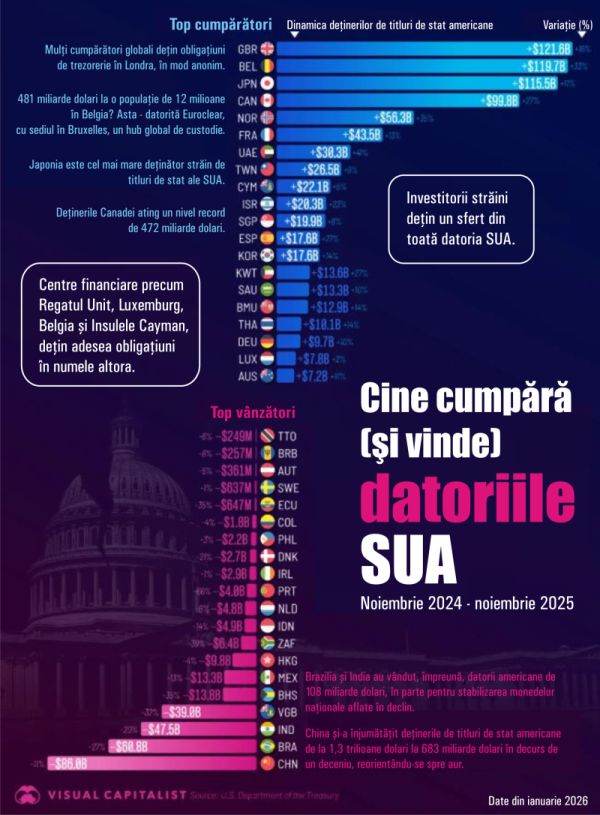
The United States relies on investors every year to finance its growing debt, which will reach $38.6 trillion as of February 2026.
Both domestic and foreign investors are buying this debt, with foreign investors holding a record $9.4 trillion in US Treasuries, according to visualcapitalist.com. While US debt is profitable due to its currently high yields, some countries, such as China, have been selling their US Treasuries.
The cited source presents a ranking of the countries that are the 20 largest buyers and sellers of US government bonds from November 2024 to November 2025, based on data from the US Treasury Department.
• Europe and Japan lead purchases of US government bonds
The main countries that bought US Treasury bonds from November 2024 to November 2025, both in terms of the value in US dollars and the percentage change in their holdings, are the United Kingdom, Belgium and Japan, each with purchases exceeding $115 billion. The United Kingdom led these purchases, with almost $122 billion (+16% annually), followed by Belgium ($119.7 billion; +33%) and Japan ($115.5 billion; +11%). Canada and Norway came in fourth and fifth, with $99.8 billion (+27%) and $56.3 billion (+35%), respectively. Together, these five countries accounted for about 65% of the $786 billion in total purchases.
The source cited notes that in the case of Belgium, the 33% increase is largely technical: Brussels is home to Euroclear, a clearing house that holds bonds on behalf of investors in Europe. Therefore, the number may indicate where the debt is held, rather than who actually purchased it. The same logic applies to other financial centers, such as the United Kingdom, the Cayman Islands and Luxembourg.
In the aforementioned ranking, places 6-10 look like this: France ($43.5 billion; +13%), United Arab Emirates ($30.3 billion; +41%), Taiwan ($26.5 billion; +9%), Cayman Islands ($22.1 billion; +5%), Israel ($20.2 billion; +23%).
• China, Brazil and India lead US bond sales
China has given up $86 billion in US Treasury bonds, representing an 11% annual decline, which continues a multi-year reduction in US debt holdings as Beijing diversifies its reserves into gold and other assets, according to the cited source.
Other BRICS countries, such as Brazil and India, have also reduced their holdings by a total of more than $108 billion. Brazil sold $60.8 billion (-27%), India - $47.5 billion (-20%). This movement partly reflects the efforts of governments to defend their own currencies, but could also indicate a continuing trend of de-dollarization.
After the three countries mentioned, up to the tenth position, the ranking looks like this: British Virgin Islands (-$39 billion; -32%), Bahamas (-$13.8 billion; -35%), Mexico (-$13.3 billion; -13%), Hong Kong (-$9.8 billion; -4%), South Africa (-$6.35 billion; -39%), Indonesia (-$4.86 billion; -14%), Netherlands (-$4.75 billion; -6%).
• China's share of US Treasuries - at its lowest level in 25 years
China has been steadily reducing its holdings of US government debt, and a post by the analysis provider The Kobeissi Letter, on the X network, shows that the Asian country's share of total foreign holdings of US securities has reached 7.3%, the lowest level since 2001, according to economictimes.indiatimes.com. This share was much higher before - 28.8% in June 2011, for example, which means it has fallen by about 21.5 percentage points since then.
China currently holds about $683 billion in U.S. Treasuries, the lowest level since 2008. That means the Asian country has sold about half of the U.S. bonds it bought between 2000 and 2010. At the same time, China has been buying gold instead of bonds. In January alone, China's central bank bought one ton of gold, marking its 15th consecutive month of gold purchases. China's total gold reserves now stand at a record 2,308 tons, according to the source. Experts say this clearly shows that the Chinese state is moving away from U.S. Treasuries and toward gold. China's holdings of U.S. debt peaked in 2013, and their continued decline is due to Beijing's reduction in financial dependence on the United States. Industry officials say this also helps reduce risk if markets become volatile.
Another reason for the cuts is political tensions between the US and China over trade, technology and Taiwan. China is also concerned that in 2022 the US and its allies froze about $300 billion in Russian reserves after the invasion of Ukraine. China fears that a similar action could happen to its dollar assets in extreme situations.
Total foreign holdings of U.S. Treasury bonds rose to a record $9.4 trillion.


























 Euro
Euro Dolar SUA
 Franc elveţian
 Liră sterlină
 Gram de aur