 English


The adoption of the euro in Croatia and Bulgaria offers, for the first time since the sovereign debt crisis, a relevant test of how the euro area functions in a fragmented world.
We are no longer talking about entries into a monetary union undergoing expansion and accelerated convergence, but about accessions carried out in a context of selective capital, high geopolitical risk, and increasingly visible structural differences between states.
From this perspective, the essential question is not whether the euro has "worked” technically, but what it has concretely meant for citizens.
• Stability without immediate prosperity
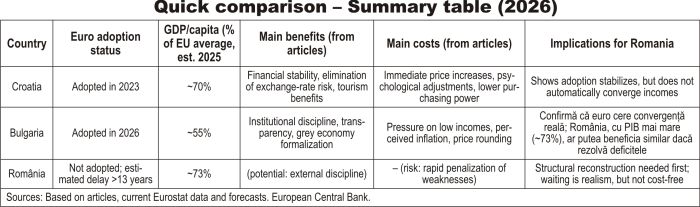
In Croatia, adopting the euro formalized an already existing reality.
The economy was heavily informally euroized, and eliminating exchange-rate risk brought financial stability and predictability, especially for the banking sector, tourism, and investment.
For citizens, however, the transition was perceived differently.
In the first months after the introduction of the euro, the population felt a visible rise in the cost of everyday life, particularly for services, dining, and small routine expenses.
Psychological conversion and price rounding favored increases, while wages and pensions did not keep pace.
Even though official inflation did not explode, perceived purchasing power declined, and social dissatisfaction was real.
The benefits of adopting the euro - the disappearance of conversion costs, the stability of savings and loans - are real but invisible in the short term for the average citizen.
They translate into lower risks, not more money at the end of the month.
The main winners were export-oriented companies and individuals with euro-linked incomes; the cost was felt more strongly by fixed-income employees and pensioners.
The euro stabilized, but did not raise living standards.
• Discipline as a social effect
Bulgaria's case is different, yet equally instructive. Bulgaria enters the euro area from a currency board regime, with a fixed exchange rate and strict fiscal discipline.
From a technical standpoint, the euro does not change the monetary mechanism, but rather formalizes it.
For citizens, the effects are predictable.
Formal conversion will also generate price increases, especially for daily consumer goods and services.
Even though the lev was already pegged to the euro, the change of currency amplifies rounding and the visibility of prices.
The impact is felt disproportionately by low-income households, pensioners, and rural communities.
The main benefit is not financial, but institutional.
The euro functions as an instrument of discipline and transparency, reducing room for "hidden” inflation and forcing the formalization of segments of the grey economy.
This process may bring long-term gains, but it does not immediately offset the pressure on the cost of living.
For the citizen, the euro means more order, not more prosperity.
• The common lesson
The cases of Croatia and Bulgaria show that the euro area is no longer an automatic accelerator of prosperity. The single currency stabilizes and disciplines, but it does not erase structural differences and does not guarantee rapid income convergence.
In a context of financial fragmentation, the currency is common, but the price of money and living standards remain local.
For citizens, the costs are immediate and easy to notice - higher prices, psychological adjustments, pressure on daily budgets. The benefits are diffuse, delayed, and often perceived only indirectly, through macroeconomic stability or lower risks.
This is the essential lesson for Romania. Adopting the euro can no longer be presented as a promise of rapid prosperity.
Without solid income growth and without a sufficiently competitive economy, the single currency risks being experienced by citizens as higher prices, not as a gain.
Croatia and Bulgaria do not demonstrate that the euro is a mistake.
They demonstrate something more uncomfortable: the euro works, but demands far more than it offers in the short term.
In a fragmented monetary area, stability comes before prosperity, and the cost of that order is borne first by the citizen.
NOTE
The analysis is based on reports from the European Central Bank, Eurostat, national central banks, the European Commission, as well as on debates and analyses published over time in Ziarul BURSA.





















 Euro
Euro Dolar SUA
 Franc elveţian
 Liră sterlină
 Gram de aur





























