English


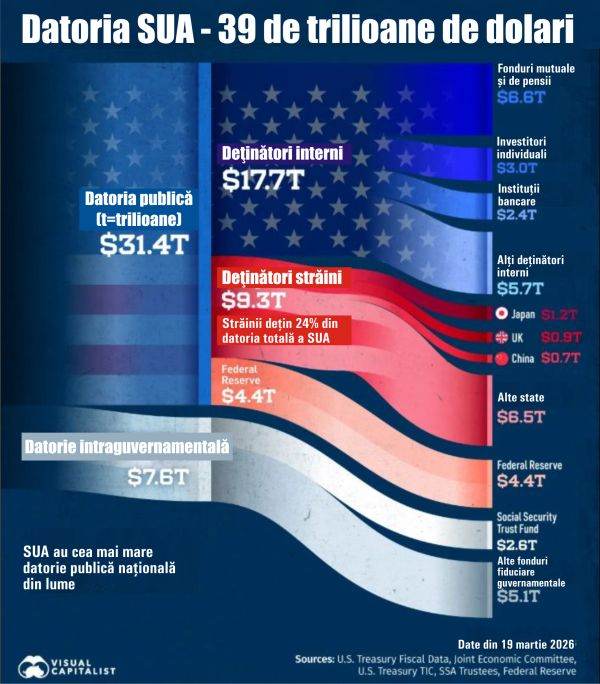
The US relies on a wide range of buyers of government bonds, including domestic institutions, foreign governments and its own central bank, to finance its growing deficits.
A visualcapitalist.com analysis shows who finances the $39 trillion U.S. debt and how much of it is held by domestic and foreign investors, according to data provided by the Treasury, the U.S. Joint Economic Committee, and the Federal Reserve, as of March 19, 2026.
Of the $39 trillion that makes up the United States' gross debt, $31.4 trillion (81%) is held by domestic and foreign investors. The remaining $7.6 trillion (19%) is intragovernmental debt, reflecting domestic government transactions. This total is about twice the combined wealth of the world's top 20 billionaires.
Publicly held debt represents what the U.S. owes to foreign investors and directly influences interest rates, borrowing costs, and financial markets. By contrast, intragovernmental debt is money that the government owes itself, primarily through programs like Social Security.
• Mutual and pension funds - the largest holders of U.S. public debt
Mutual and pension funds are the largest holders of U.S. public debt ($6.6 trillion), reflecting strong demand for safe, liquid assets. The Federal Reserve holds $4.4 trillion on its balance sheet, more than the top three foreign creditors - Japan, Britain, and China - combined.
Among individuals, Warren Buffett, through his Berkshire Hathaway company, is the largest non-government holder of U.S. Treasuries, with $339 billion in the last quarter of 2025.
• What the high U.S. debt means for the average American
The U.S. is among the top ten countries with the highest debt levels globally in terms of debt-to-GDP ratio, and its debt is growing by about $1 trillion every three months. This trend can affect Americans' standard of living, the cited source notes. As debt grows, a larger portion of the federal budget is allocated to interest payments, which eliminates spending on priorities such as infrastructure, defense and social programs. Excessive debt can slow wage growth and job creation, while contributing to rising interest rates, which makes loans, mortgages and credit card debt more expensive.
As the national debt continues to grow, its composition and ownership remain essential for understanding the risks to financial markets and the economy as a whole, the cited source concludes.
• Europe and Japan lead foreign purchases of US government bonds
The top countries that bought US Treasury bonds from November 2024 to November 2025, both in terms of the value in US dollars and the percentage change in their holdings, were the United Kingdom, Belgium and Japan, each with purchases exceeding $115 billion, according to visualcapitalist.com. The United Kingdom led these purchases, with almost $122 billion (+16% annually) during the said period, followed by Belgium ($119.7 billion; +33%) and Japan ($115.5 billion; +11%). Canada and Norway came in fourth and fifth, with $99.8 billion (+27%) and $56.3 billion (+35%), respectively. Together, these five countries accounted for about 65% of the $786 billion in total purchases.
The source cited notes that in the case of Belgium, the 33% increase is largely technical: Brussels is home to Euroclear, a clearing house that holds bonds on behalf of investors in Europe. Therefore, the number may indicate where the debt is held, rather than who actually purchased it. The same logic applies to other financial centers, such as the United Kingdom, the Cayman Islands and Luxembourg.
In the aforementioned ranking, places 6-10 look like this: France ($43.5 billion; +13%), United Arab Emirates ($30.3 billion; +41%), Taiwan ($26.5 billion; +9%), Cayman Islands ($22.1 billion; +5%), Israel ($20.2 billion; +23%).
• China's share of US Treasuries - at its lowest level in 25 years
China has been steadily reducing its holdings of US government debt, and a post by the analysis provider The Kobeissi Letter, on the X network, shows that the Asian country's share of total foreign holdings of US securities has reached 7.3%, the lowest level since 2001, according to economictimes.indiatimes.com. This share was much higher before - 28.8% in June 2011, for example, which means it has fallen by about 21.5 percentage points since then.
China currently holds about $683 billion in U.S. Treasuries, the lowest level since 2008. That means the Asian country has sold about half of the U.S. bonds it bought between 2000 and 2010.
China's holdings of U.S. debt peaked in 2013, and their continued decline is driven by Beijing's reduced financial dependence on the United States. Industry officials say this also helps reduce risk if markets become volatile.





















 Euro
Euro Dolar SUA
 Franc elveţian
 Liră sterlină
 Gram de aur