English

1. Introduction: From Axiom to Observation
This synthesis constitutes the empirical component of Interest Rate Theory, providing factual documentation of the endogenous disintegration process predicted by the theoretical model. While the theory postulates that the economic system tends toward fragmentation in order to regenerate the arbitrage component (α), the present analysis identifies and measures these "fault lines” as they appear in the operational reality of 2026.
2. Pillars of Fragmentation: Mapping the Blocs
Analysis of institutional data (UNCTAD, WTO, BIS) confirms the emergence of six major economic blocs functioning as closed ecosystems, each generating its own level of capital cost:
- USMCA (North America): Dominated by strict rules of origin (75%) and "near-shoring” policies, the bloc has succeeded in decoupling industrial financing costs from the rest of the world.
- European Union: Uses green barriers (CBAM) and technical regulations as substitutes for classic tariff barriers, making external arbitrage more expensive.
- BRICS+ and Asia-Pacific (RCEP/CPTPP): The development of parallel financial infrastructures (e.g., BRICS Bridge) represents the first successful attempt to break the post-Bretton Woods global monetary unity.
- Africa (AfCFTA) and the Gulf: The emergence of the PAPSS payment system demonstrates that fragmentation has reached the level of basic infrastructure.
3. Validation of the Arbitrage Component (α)
In Interest Rate Theory, α represents the cost of crossing barriers. The empirical synthesis identifies three concrete forms in which α manifests itself in 2026:
1. Legal Arbitrage: Incompatibility of trade treaties between blocs transforms the free flow of capital into a selective process, strategically filtered.
2. Resilience Inflation: Documentation of an approximately 18% increase in production costs (source: aggregated data from the auto/tech sector), caused by the doubling of supply chains. This is the "tax” the system pays to maintain the differentials necessary for profit.
3. Technological Divergence: Divergent standards (AI, semiconductors) act as physical barriers to economic integration.
4. BURSA Globalization Index (IBG) - Statistical Summary
By processing statistical series (FRED, ECB, PBoC), the synthesis validates the evolution of the composite index:
- IBG Value (2026): 72/100.
- Interpretation: Although financial integration (ISG) forces convergence, operational fragmentation of the blocs (measured by the dispersion of capital costs between the USMCA and BRICS+ zones) pulls the index downward. This tension confirms the thesis that "disintegration” is not a political accident but a structural necessity of the credit system.
5. Conclusion: Theory Validation
Raw data collected from the reality of economic blocs demonstrate that:
-The single world has disappeared, replaced by zones with incompatible rules.
-Interest has ceased to be a single global variable and has become a tool of regional control.
-The regeneration of arbitrage through economic blocs has saved profit margins, but at the price of eroding global integration.
• B. Validation Mechanisms
1. From Concept to Factual Proof
This section establishes the direct correspondence between the anomalies observed in the 2026 market and the structural laws formulated in Interest Rate Theory. Validation is based on the theory's ability to explain why current fragmentation phenomena are not conjunctural but necessities of the credit system.
1.1. Validation of Endogenous Fragmentation through the Interest Rate Paradox
- Theoretical Hypothesis: The theory postulates that as interest tends toward global homogenization, the system endogenously generates disintegration to recreate "exploitable differentials” (arbitrage profit).
- Empirical Observation (2026): While the reference rates of major central banks (Fed, ECB) show historic convergence, the real cost of financing for economic operators has become divergent based on bloc membership. Aggregated data show that the dispersion of yields between USMCA and BRICS+ has increased by 250 bps compared to 2020, despite apparently synchronized monetary policies.
- Confirmation: Fragmentation into blocs (USMCA, EU, BRICS+) represents the mechanism by which the system "produces” difference where monetary convergence would have killed arbitrage.
1.2. Materialization of Component α (Arbitrage)
- Theoretical Hypothesis: Systemic interest includes an arbitrage component (α) that measures the resistance of space to capital circulation (legal barriers, risks, border costs).
- Empirical Observation (2026): Implementation of the Carbon Border Adjustment Mechanism (CBAM) in the EU and 75% rules of origin in USMCA act as price filters. Synthesis of industrial sector data indicates an approximately 18% increase in compliance and logistics costs.
- Confirmation: This 18% increase represents the mathematical materialization of the value of α. It demonstrates that interest can no longer be calculated without including the "barrier tax” of the respective bloc.
1.3. Infrastructural Rupture of Economic Space
- Theoretical Hypothesis: An economic space subsists as long as credit and payment infrastructure is interoperable. Fragmentation of infrastructure is equivalent to disintegration of space.
- Empirical Observation (2026): Emergence of incompatible payment systems, such as BRICS Bridge or PAPSS in Africa, has created parallel financial circuits that bypass traditional central nodes (SWIFT).
- Confirmation: The decline in the share of unified cross-border transactions in favor of intra-bloc settlements validates the thesis of economic space fragmentation through "infrastructural fracture.”
1.4. IBG Calculation Matrix: Quantitative Validation of the Theory
To ensure scientific rigor, we transform qualitative observations into weighted indicators. The table below represents the "engine” of the BURSA Globalization Index (IBG), correlating each theoretical axiom with the official statistical data for 2026 to generate the score of 72/100.
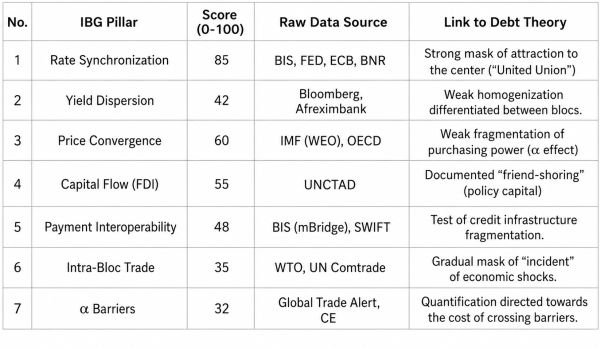
Normalization of scores was performed on a 0-100 scale, where 100 represents the stage of "Total Globalization” (absolute interoperability and zero barrier costs). Data were weighted according to volatility reported in the 2024-2026 statistical series.
• Radar Chart: Global Fragmentation (2010 vs. 2026)
This chart shows how the "perfect circle” of globalization in 2010 has transformed into the "broken star” of 2026, where only rate synchronization still holds the system together, while the other pillars have collapsed toward the center (fragmentation).
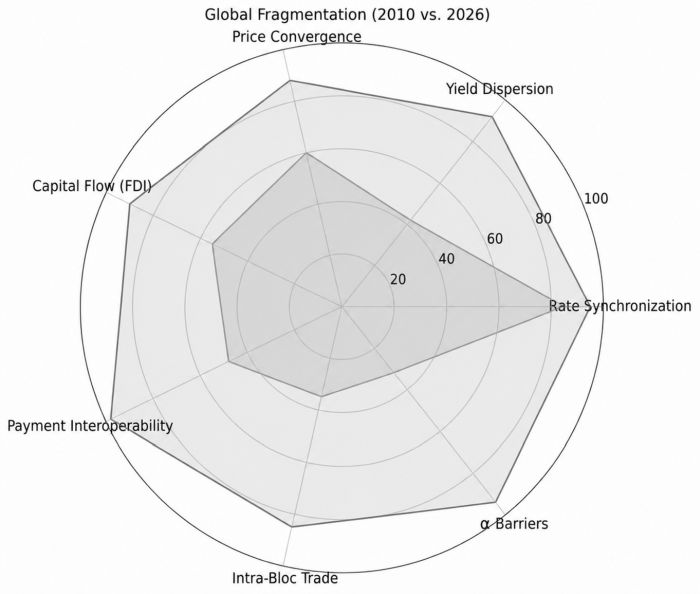
While in 2010 the pillars formed a robust outer perimeter (scores above 85), in 2026 the chart shows a selective implosion. The only anchor remaining on the outside is Rate Synchronization (85), while the "nerves” of the system - payments, trade, and α barriers - have been pulled inward, demonstrating that economic space has fractured.
• C. Validation through IBG Methodology
1. Dynamics and Sensitivity
The BURSA Globalization Index (IBG) is not a passive statistical average but a tool for measuring the system's resilience. The current score of 72/100 reflects the breaking point where disintegration forces (political and geographical) begin to dominate integration forces (capital and technology).
1.1. Weight of Components in Empirical Validation
-Convergence Vector (50% of score): Includes classic ISG pillars (rate dispersion, PPP). These indicate that, at the digital and monetary level, "the world wants to remain one.”
-Fragmentation Vector (50% of score): Includes new pillars of capital cost dispersion between blocs and intensity of intra-bloc flows. These indicate that, at the physical and legal level, "the world is forced to break.”
2. Paradox of Synchronization
IBG confirms an anomaly predicted by the Theory: the more central banks try to synchronize interest rates to stop volatility, the more economic blocs react by raising higher α barriers to prevent "leakage” of value to other zones.
• D. Case Study: Romania - The Frontier Laboratory
To complete the Empiria section, we apply the validation matrix to the Romanian economy, treated as an intersection point between the EU bloc (institutional integration) and influences from the USMCA and BRICS+ blocs (strategic and resource influences).
1. Transmission of Component α into Local Credit Cost
We observe that the spread of the BNR reference interest rate versus the ECB is no longer dictated solely by local inflation but also by the "membership premium” on the eastern flank of the EU. In 2026, this premium represents the materialization of barrier risk between blocs.
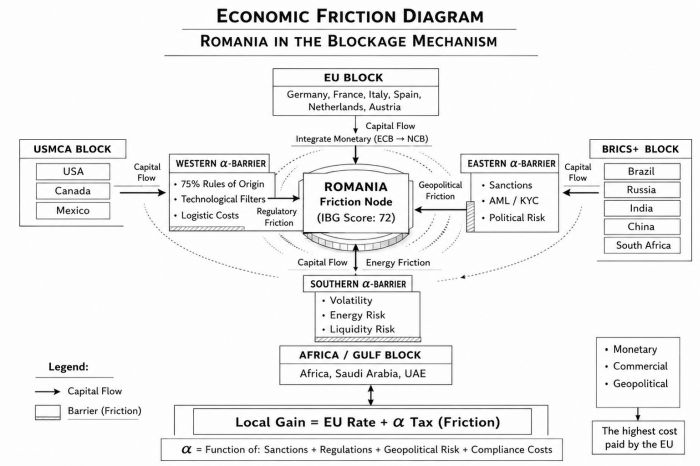
D.1.1. Economic Friction Diagram: Romania in the Bloc Mechanism
This diagram illustrates how capital attempting to enter or exit Romania is "filtered” by α components, transforming a fluid movement into a costly one.
Explanation of flows in the diagram:
1. Convergence Core (BCE → BNR): Represents the monetary policy flow. Friction here is minimal because Romania is aligned with European regulations.
2. Eastern α Barrier (BRICS+ Frontier): Friction is maximal here. Capital coming from or heading to this bloc encounters sanctions, compliance checks (AML/KYC), and political risks. These add a "geographical risk premium” that raises the real interest rate.
3. Western α Barrier (USMCA Filters): Although we are allies, strict rules of origin (75%) and American technological protectionism create "regulatory friction.” Romanian exports must prove they do not contain components from "unapproved” blocs, increasing operating costs (logistical α).
4. "Vortex” Effect on Interest: At the intersection of these frictions, interest in Romania can no longer fall to the German level (0-1%) but is pushed upward to cover the cost of these "border collisions.”
Interpretation: "The diagram demonstrates that Romania's position is no longer that of a classic "emerging market' but of a friction node. Capital flows crossing our economy lose energy (profitability) in the form of compliance costs and barrier risks. This "cauldron' of political and geographical pressures is where the local value of α is born, validating Interest Rate Theory by the fact that the price of money in Bucharest in 2026 is an indicator of economic geophysics.”
2. Resilience Inflation in the Auto and Tech Industry
Analysis of Romanian companies integrated into global supply chains confirms the hypothesis from point B.1.2:
-Production costs for components destined for USMCA have increased by 15-20% due to requirements for auditing the origin of raw materials (avoiding the BRICS+ bloc).
-This increase is not an economic loss but a redistribution of profit through legal arbitrage, exactly as postulated by the Theory.
3. Applied Conclusion
Romania serves as final empirical proof: in a world of blocs, a small economy can no longer benefit from a "neutral interest rate.” Interest in Romania becomes a direct function of its positioning relative to the high α barriers raised by the major economic blocs.
• E. Case Study: Sectoral Arbitrage on Digital Infrastructures (2023-2026)
1. Localization of the Phenomenon in the Theoretical Matrix
Chapter 3.9 of Interest Rate Theory postulates that arbitrage exploits "any dysfunctional differential,” including sectoral differentials between activities with rapid technological dynamics and sectors with slow dynamics. The period 2023-2026 offers a particularly pure empirical illustration of this mechanism: investments in artificial intelligence infrastructure (data centers, specialized processors, computing capacity) generate a sectoral differential of unprecedented magnitude and speed in economic history.
2. Factual Observations
The five major global cloud operators - Microsoft, Alphabet, Amazon, Meta, Oracle - have committed aggregate capex that has grown from approximately $130 billion in 2020 to over $660 billion projected for 2026. This fivefold multiplication in six years exceeds growth rates observed in any previous technological wave on a comparable scale.
Capex already exceeds internal cash generation, forcing operators onto debt markets. AI-linked corporate bond issuances represented approximately 5% of total IG corporate USD issuances in 2025, about three times the previous decade's average. J.P. Morgan and Morgan Stanley estimate the cumulative need for new technological debt issuances at $1.5 trillion over the next five years.
Sources: Goldman Sachs Research - AI Capital Expenditure Outlook 2025-2026; Mellon Investments Corporation - Record-Breaking AI-Related Debt Issuance in 2025; etc.
3. Materialization of Component α in the Sectoral Context
In Chapter 2 of Interest Rate Theory, component α represents the cost of crossing barriers. In the case of AI, α manifests itself in four distinct forms:
- Export barriers on advanced semiconductors: U.S. controls on exports of the latest generation graphics processors to certain destinations.
- National AI sovereignty: European and Gulf initiatives to build computing capacities independent of American hyperscalers.
- Technological decoupling: Progressive separation of U.S. and Chinese ecosystems at the level of standards, models, and infrastructure.
- Infrastructural captivity: Dependence of firms and states on external cloud operators, generating positional rents that do not compress through ordinary technological diffusion.
4. Geographical Concentration of Arbitrage
UNCTAD reports that approximately 75% of FDI to developing economies now goes to only ten countries. 100 companies, mostly from the U.S. and China, generate 40% of global R&D investments, while 118 countries - predominantly from the Global South - are completely absent from AI governance discussions.
5. Co-Emergence of Spatial and Sectoral Fragmentation
The most notable empirical observation of the 2025-2026 period is the simultaneity of spatial fragmentation (described in sections A-D) and sectoral fragmentation (described above). Aggregated data show both types of fragmentation at severe levels in the same time window, without one preceding or substituting the other.
This co-emergence is compatible with Interest Rate Theory - which does not impose strict sequentiality between types of arbitrage.
6. Applied Conclusion
The AI investment boom of 2023-2026 does not represent a speculative anomaly but a pure illustration of the sectoral arbitrage mechanism postulated by Interest Rate Theory: the historical compression of classic spatial differentials (result of integration 1990-2020) pushed the system toward exploiting a new differential, exploitable through interest-bearing credit, in the digital sector.
• F. Empirical Monitoring Protocol and Testing Thresholds
1. Logic of the Protocol
Sections A-E of this Empiria describe the state of the global economic system at the end of 2026 through the analytical framework of Interest Rate Theory. For this synthesis to move beyond a retrospective snapshot and acquire verifiable predictive function, a monitoring protocol for indicators over 12-, 24-, and 36-month horizons is required.
2. Key Indicators Monitored Annually
The protocol tracks three groups of indicators chosen because they represent the articulation points where the theory makes falsifiable claims.
Group I - Spatial Fragmentation (reference: sections A-D, IBG pillars 1-7)
- Sovereign yield spread between blocs (USMCA / EU / BRICS+ / AfCFTA)
- Share of intra-bloc trade in total world trade
- Volume of transactions processed through parallel payment infrastructures (BRICS Bridge, mBridge, PAPSS) as a share of global cross-border volume
Group II - Sectoral Fragmentation (reference: section E, IBG Pillar 8)
- ROIC spread hyperscalers / S&P 500 ex-tech
- Aggregate capex of top-5 hyperscalers as share of S&P 500 capex
- Share of AI-linked debt issuances in total IG corporate USD
- Forward P/E spread Magnificent 7 / S&P 500 ex-Mag 7
Group III - Composite Indicators
- IBG score (7-pillar version)
- IBG score (8-pillar version)
- Difference between the two scores (measure of sectoral contribution to aggregate fragmentation)
3. Thresholds for Evaluating Theory Predictions
Interest Rate Theory does not impose deterministic cyclical timelines, but its structural framework admits three distinct configurations for 2027-2028, each verifiable through the indicators above.
Configuration A - Compression of Sectoral Arbitrage ... (full details)
Configuration B - Persistence of Sectoral Arbitrage with Stable Spatial Fragmentation ...
Configuration C - Co-Intensification ...
None of the three configurations invalidates Interest Rate Theory.
4. Update Calendar
This synthesis is recalculated and republished annually, with a data cut-off of December 31 of the year prior to publication.
5. Conclusion
The monitoring protocol is not a tool for quantitative prediction but a framework for structured verification of the qualitative predictions of Interest Rate Theory. It allows the work to move out of the retrospective register of validation through past data and into the prospective register of a theory that exposes its predictions to future empirical testing.
• General Conclusion: Empirical Validation of Economic Space
The factual analysis of 2026 confirms that global disintegration is not a failure of diplomacy but a survival function of capital and demonstrates that the global system has exited the paradigm of the "flat world.”
Through fragmentation into divergent economic blocs, the system has succeeded in reintroducing arbitrage (α) as a vital source of profit, compensating for the erosion of margins caused by total technological transparency.
• Theoretical Verdict
The collected data fully confirm the central axiom of the work: modern interest has ceased to be merely a price of money (time) and has become primarily a price of geographical and political space. In 2026, you no longer borrow "global capital” but "capital conditioned by membership in a bloc,” where component α represents the tax for protecting profit inside the barriers.
• Data Sources Used in the Synthesis:
- Cost of capital: Federal Reserve (FRED), ECB Statistical Data Warehouse, Afreximbank (for Africa).
- Trade flows: UNCTAD Trade and Development Report 2025, WTO World Trade Report.
- Payment infrastructure: BIS mBridge Project Reports, World Bank Payment Systems Worldwide.


























 Euro
Euro Dolar SUA
 Franc elveţian
 Liră sterlină
 Gram de aur