English

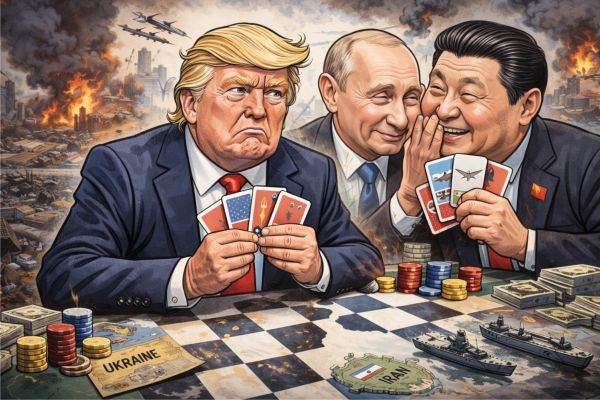
Viewed separately, the war in Ukraine and the U.S.-Israeli war with Iran seem to belong to distinct geopolitical theaters. This appearance, however, is deceptive. The two conflicts are structurally linked-through common adversaries, shared military resources, and interdependent economic consequences. Analysts are beginning to speak, with increasing insistence, about the possibility of a merger into a single geopolitical field of forces-and about who exactly wins from this fusion.
• The Common Axis: Russia, Iran, North Korea
The starting point of any honest analysis is that Russia and Iran are not independent adversaries of the West, but members of the same strategic bloc. The military ties between China, Russia, Iran, and North Korea-the "Axis of Evil," as Bush Jr. called it-are continually deepening, and for the first time in history, the United States' adversaries are willing to grant each other direct military aid, including on other continents, RAND analysts observe.
This convergence has its own history and logic. Russia's 2022 invasion of Ukraine served as a dramatic catalyst for the consolidation of this bloc: to sustain its war effort, Russia imported Iranian weapons, and North Korea provided vital support, according to the Center for a New American Security. The cooperation is not unilateral: Iran supplies Russia with combat drones, ballistic missiles, artillery shells, infantry ammunition, anti-tank missiles, and glide bombs, even contributing to the construction of a drone factory on Russian territory, while North Korea has delivered artillery pieces, ballistic missiles, and millions of shells, sending approximately eleven thousand soldiers to the front, according to the Washington Institute for Near East Policy.
The bloc is not a formal alliance, but its strategic coherence is real. The term "Axis of Upheaval" was proposed in April 2024 by analysts Richard Fontaine and Andrea Kendall-Taylor of CNAS precisely to describe this convergence without resorting to "overly heavy" language like Bush's "Axis of Evil." NATO's Head of Policy Planning, Benedetta Berti, preferred the term "strategic convergence" to designate the same phenomenon, according to the same source. It is important to approach the combined global challenge of these axes as a comprehensive strategic system, not as two sets of separate problems spread across Europe, the Middle East, and the Indo-Pacific, recommends the Washington Institute for Near East Policy.
• War Launched Without Analysis
Before examining the operational connections between the two conflicts, a preliminary question arises: was the war with Iran launched based on sound strategic calculations? Available data suggests the answer is no.
A classified report by the U.S. National Intelligence Council, finalized about a week before the attacks on Iran were launched, warned that neither limited strikes nor an extended military campaign were likely to lead to regime change in Tehran, and that no strong, unified opposition coalition was ready to take power, according to the Washington Post. The White House refused to comment on whether Trump was informed of this assessment before launching the attacks, the same source notes.
The administration's public justifications have been repeatedly contradicted by its own intelligence assessments. Trump and his top officials misrepresented and exaggerated the threat Tehran posed to the U.S. on several occasions leading up to the attacks, according to sources and unclassified intelligence assessments cited by CNN. Trump claimed Iran was building missiles that "will soon reach the United States"-a claim unsupported by any U.S. intelligence assessment, according to the same source.
Almost every aspect of the conflict has been questioned since its inception: the initial rationale, the Trump administration's strategy for ending hostilities, and what happens after the cessation of hostilities-who takes power, how the country is stabilized, observes Time Magazine. Questions persist because Trump and his officials have offered contradictory answers, ranging from the limited goal of preventing the development of Iranian nuclear weapons to the maximalist goal of overthrowing the Islamic Republic through a popular uprising, the same source emphasizes.
The conditions that typically produce short wars-a decisive military advantage, an adversary willing to negotiate, and a clear political objective-are strikingly absent in this conflict, warns Time Magazine. How can Trump end a war he himself started if he doesn't even know what he wants to achieve? asks CNN Politics.
• The First Operational Connection: The Patriot Interceptor Crisis
The absence of prior calculations immediately materialized in a first operational connection with the war in Ukraine: competition for the same weapons systems. Ukraine depends on the Patriot system to intercept Russian Iskander and Kinzhal ballistic missiles.
Russian night attacks with ballistic missiles reached, in February 2026, their highest intensity in four years of war, with some salvos including up to 30 ballistic missiles in a single wave, according to the Foreign Policy Research Institute. Even before the escalation of the Iranian crisis, Washington was already reluctant to deliver additional Patriot interceptors and launchers to Kyiv due to global commitments and limited stockpiles, according to the same source.
Patriot interceptor stockpiles were at a quarter of capacity before the war began, according to American Prospect. The U.S. and its allies fired over 1,000 PAC-3 Patriot interceptors in the first eleven days of the conflict-nearly double the total of 600 PAC-3 interceptors received by Ukraine in the four years of war since the Russian invasion, Bloomberg reports. American manufacturers can produce at most 550-600 PAC-3 interceptors per year-a figure that did not cover global demand even before the war, notes Reuters. The recent agreement signed with Lockheed Martin to increase production to 2,000 units per year will not take effect for six to seven years, specifies Euromaidan Press.
The major assets used in the war in Iran-air defense systems, long-range weapons, naval vessels, aerial refueling, and intelligence capabilities-are exactly the same ones the U.S. would need for national defense and a potential conflict with China, warns the Atlantic Council. How the United States will manage to rebuild its combat readiness for great power competition remains an open question, the same source observes.
• The Second Operational Connection: Oil and the Strategic Paradox
The second connection is economic, but no less structural, and is governed by a paradox that analysts are only now articulating in all its complexity. The closure of the Strait of Hormuz hits Western economies and simultaneously enriches Russia.
At the price of $106.81 per barrel recorded on March 8, Russia was accumulating an estimated additional gain of approximately $118 billion per year compared to the price at the beginning of the year, indicates a Data Republican analysis. Every ten-dollar increase in the price of a barrel brings Moscow approximately $25 billion in additional annual revenue, according to the same source. Before the attacks on Iran, Russia was forced to sell its oil at a discount of $10-13 per barrel; now, Russian oil is selling at a premium of $4-5, Reuters reports, as cited by American Prospect. It is in Putin's interest for the war to last as long as possible, the same source concludes.
The paradox becomes even deeper when examining Iran's own behavior. Although it closed the Strait of Hormuz to Arab producers and Western energy flows, Iran manages to sell its own oil-and even more so than before the conflict. Iranian vessels loaded an average of 2.1 million barrels per day between March 5 and 10-more than the 2 million barrels exported in February, according to market intelligence platform Kpler, cited by the Wall Street Journal. Iran has sent at least 11.7 million barrels of crude oil through the Strait of Hormuz since the start of the war, all destined for China, according to TankerTrackers.com. Iran blocks the Strait for its regional rivals but continues its own exports, creating a situation where competitors are paralyzed while it continues to collect revenue, the Wall Street Journal indicates. "Otherwise they have no money," David Roche of Quantum Strategy told CNBC.
This reality forced an embarrassing political decision for Washington: on March 12, the U.S. Department of the Treasury issued General License 134, temporarily authorizing the trading of Russian oil at sea with the aim of stabilizing global energy prices, according to the document published on the official Treasury website. In other words, to manage the economic consequences of a war launched without adequate prior calculations, Washington was forced to weaken-at least temporarily-the sanctions regime against Moscow, precisely while Moscow continues to support Tehran. Ten Democratic senators warned that "the license allows billions of dollars to reach Russia and Russian intermediaries, exactly at the moment when U.S. officials confirmed that Russia is providing Iranian forces with the locations of American assets, including warships and aircraft," as stated in the senatorial letter addressed to the Banking Committee.
• Who Wins? Russia and China!
The question of who benefits from this war has already received an explicit answer in the Western press of record. The disruption of oil supplies benefits the Russians, as does the reduction of American aid to Ukraine, and the war in Iran distracts attention from China, observes the Washington Post. It would be extraordinary if Putin emerged as the primary winner of the Middle East crisis precisely because Trump shook global energy markets by launching his own war, concludes CNN Politics.
Russia gains new resources to finance its war against Ukraine as energy prices rise and profits from the diversion of Western military capabilities, declared European Council President Antonio Costa, cited by NBC News. Russia has provided Iran with sensitive information, including the precise locations of American warships and aircraft operating in the Middle East, three senior U.S. officials told the Washington Post-and Russian intelligence operators are actively helping the Iranian regime identify American targets specifically to keep Trump bogged down in Iran for as long as possible, American Prospect notes. Furthermore, Russia is helping Iran not only with drones but also with missiles and air defense systems, said Ukrainian President Volodymyr Zelensky, cited by CNN Politics.
China, for its part, receives Iranian oil at reduced prices and Russian oil at a discount, strengthening its economic advantage over the West. By abandoning Ukraine in favor of an all-out air war against Iran, Trump has done an immense service to a much more serious threat-Vladimir Putin's Russia, concludes American Prospect.
None of the sources consulted claim that Trump intentionally launched the war in favor of Russia and China. What the sources document instead-and it is equally grave-is that a war launched without adequate strategic calculations, based on justifications contradicted by the administration's own intelligence assessments, has objectively produced exactly the results the Russia-Iran-China bloc sought: the exhaustion of the Western arsenal, rising oil prices, and the weakening of sanctions against Moscow.
• Convergence: Toward a Single War System
As the United States' adversaries draw closer to one another, the chances of a conflict in one region contaminating another part of the world increase dramatically, warns RAND. The two identified connections-the interceptor crisis and the oil mechanism-are not accidental. They stem from the architecture of a single strategic bloc in which Russia, Iran, and North Korea coordinate their resources, technologies, and pressure on the West.
The axis of hostility toward the U.S.-led international order extends beyond the Middle East and involves actors more dangerous than Iran and its proxies-namely nuclear-armed states: Russia, China, and North Korea, observes The Hill. Even if the Trump administration managed to stop the wars in Ukraine and the Middle East, the forming axis between China, Russia, Iran, and North Korea will persist, for the simple reason that it remains in the strategic interest of all four states to maintain it, RAND emphasizes.
The most worrying scenario is not a deliberate political decision to merge the two conflicts, but a gradual and uncontrolled slide: limited military and economic resources, simultaneously redistributed between two theaters of operations without adequate strategic planning, weaken both fronts-exactly the result the Russia-Iran-North Korea bloc is coordinately pursuing. The question is no longer whether the two wars interfere. They are already interfering-through the same weapons, through the same oil, and through the same common adversary that wins simultaneously from both.





















 Euro
Euro Dolar SUA
 Franc elveţian
 Liră sterlină
 Gram de aur