English


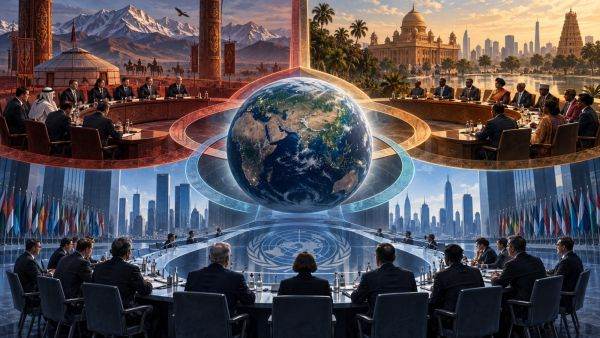
Donald Trump's expansionist policy during the first two years of his second presidential term-characterized by territorial claims and absurd tariff policies-is prompting an increasing number of states to challenge the hegemon that has led the world since World War II and to assert their place at the decision-making table in a multipolar world. This push was initiated by the BRICS group, which seeks to unite the entire Global South under its wing; it continued within the Shanghai Cooperation Organization (SCO) and, as of Tuesday, has found a new vehicle in the "Partners for Multilateralism" initiative. Curiously, the new initiative was launched just days before the bilateral meeting between Donald Trump and Xi Jinping-a move that may signal from Brazil and India that their hopes for multipolarity are not tied exclusively to the Chinese leader. The new initiative was launched in New York on the sidelines of the annual UN General Assembly, where seven political actors from different continents and geopolitical camps introduced a project that could become one of the most significant attempts to reorganize international relations in recent years. Australia, Barbados, Brazil, Canada, India, Kenya, and the European Union established "Partners for Multilateralism," a partnership open to states that uphold international law, global cooperation, and the central role of the United Nations. At first glance, the declaration adopted recently in New York might appear to be just another diplomatic document filled with rhetoric about peace, prosperity, cooperation, and sustainable development. However, when viewed against the backdrop of the Shanghai Cooperation Organization summit held in Bishkek in early September and the BRICS summit organized a few days later in New Delhi, the initiative takes on far greater significance. The "Partners for Multilateralism" initiative emerges not during a time of global consensus, but rather amidst accelerating fragmentation. Wars are proliferating, international law is applied selectively, sanctions have morphed into economic weapons, tariffs are making a strong comeback, and global supply chains are being restructured to align with the security interests of major powers. The United States, China, Russia, the European Union, and emerging powers are competing for resources, technology, markets, trade routes, and political influence. Consequently, this new initiative should be interpreted as an attempt to prevent the world from splitting into rival blocs; it represents an implicit acknowledgment that the old international order is no longer functioning and that the West cannot salvage it without India, Brazil, Africa, and the other components of the Global South.
The declaration adopted by the six initiating parties on September 21 speaks directly to the "profound global transformation," rising polarization, expanding conflicts, violations of international law, and the resurgence of power politics, protectionism, and coercion. The signatories acknowledge that economic interdependence-long regarded as a guarantee of peace-is now being wielded as a tool of pressure affecting trade, investment, supply chains, and development finance. The message conveyed by European Council President Antonio Costa following the meeting was simple: no single country can solve the world's problems on its own, and shared principles must be translated into concrete results. The initiators called upon other states to join the declaration, and senior officials from the participating nations were tasked with establishing a coordination mechanism and identifying priority areas for cooperation. On behalf of the European Union, the effort will be coordinated by the High Representative for Foreign Affairs, Kaja Kallas.
Consequently, this was not merely an announcement of intent. A first step was taken toward building a permanent political platform, open to states wishing to avoid both the collapse of the UN system and the emergence of a new world divided into antagonistic blocs.
• The economic strength of the six states signatory to the new global political partnership
However, the partnership launched in New York is not simply a diplomatic association between a few states of limited influence. The six founding countries-Australia, Barbados, Brazil, Canada, India, and Kenya-together with the European Union, represent (according to the latest comparable World Bank data for 2024) an economic force of approximately $29.7 trillion, accounting for nearly 27% of the entire global nominal gross domestic product. The European Union contributes approximately $19.5 trillion, India $3.91 trillion, Canada $2.24 trillion, Brazil $2.18 trillion, Australia $1.76 trillion, Kenya around $120 billion, and Barbados just over $7 billion. The calculation uses GDP expressed in current dollars-rather than GDP adjusted for purchasing power parity-because this measure better reflects international financial and commercial weight.
The demographic strength of the new partnership is equally significant. Together, the six states and the European Union account for approximately 2.24 billion inhabitants-around 27.5% of the global population-according to UN and World Bank data. India accounts for the largest share, with about 1.45 billion people, followed by the European Union with approximately 450 million, Brazil with around 212 million, Kenya with over 56 million, Canada with 41.3 million, Australia with approximately 27 million, and Barbados with nearly 300,000 inhabitants. In other words, more than a quarter of the planet's population lives within the political sphere represented by the initial signatories of the "Partners for Multilateralism" initiative.
Trade relations among these actors already form a substantial economic network. A conservative tally of bilateral trade in goods for 2024, as recorded by the World Trade Organization (WTO), indicates a value of approximately euro400 billion-equivalent to around $430-435 billion. The figure represents trade actually conducted between group members, with each bilateral relationship counted only once; it does not represent their total trade with the rest of the world. It is also a conservative estimate, as it does not consistently include services, for which complete and comparable statistical series are not yet available for all 21 possible bilateral relationships. The European Union forms the core of this network. Trade in goods alone between the EU and India reached euro120 billion in 2024, while trade between the EU and Australia stood at euro49.4 billion. The Union's trade in goods with Mercosur states-of which Brazil is by far the largest economy-amounted to euro82 billion, while the trade relationship with Kenya exceeded $3 billion.
Links between the six non-EU states are also significant. Bilateral trade between India and Australia reached $24.1 billion in the 2024-2025 fiscal year. In 2024, Canada's trade in goods amounted to C$13.3 billion with India, C$12.7 billion with Brazil, and C$6.1 billion with Australia. Trade between India and Kenya exceeded $3.45 billion, whereas Brazil's trade with Kenya remained much lower, at approximately $170 million.
However, these figures should not be confused with the strength of an integrated economic alliance. The European Union is a single market, whereas the "Partners for Multilateralism" group is not. There is no customs union, general freedom of capital movement, or common foreign policy among the seven signatories. Aggregate economic weight indicates the group's potential, not its automatic capacity for action. Transforming this economic and demographic mass into political influence will depend on the emergence of shared objectives, projects, and mechanisms.
• Why the new initiative matters
The fact that India and Brazil agreed to launch this project alongside the European Union, Canada, and Australia demonstrates that "Partners for Multilateralism" is not conceived as a Western alliance directed against BRICS, China, or Russia. Had that been the case, New Delhi and Brasília would not have been among the founding members. Instead, the new platform seeks to build a bridge between the West and states that challenge the current distribution of power but do not wish to replace American dominance with Chinese or Sino-Russian hegemony. It is an attempt to form a flexible center capable of cooperating with different camps and keeping the international system functional.
India is the prime example of this strategy. It cooperates militarily and technologically with the United States, expands trade ties with the European Union, purchases energy and weaponry from Russia, competes with China, participates in the SCO, and plays a major role in BRICS. Now, New Delhi is also becoming one of the initiators of "Partners for Multilateralism." This policy reflects strategic autonomy rather than indecision. India refuses to choose between a Western order that offers it insufficient power and a Sino-Russian order in which it would risk becoming a junior partner. Consequently, the Indian government participates in all key structures in order to influence their rules from within.
Brazil follows a similar logic. It seeks the reform of international institutions, the strengthening of the Global South, and more equitable representation, but does not wish to transform BRICS into a military alliance or a disciplined front against the West. Partners for Multilateralism relies precisely on these "bridge states." Its success will depend on their ability to bring together two worlds that use the same words-peace, cooperation, sovereignty, and international law-but assign them different meanings.
• Three summits and three versions of the same world
The launch of Partners for Multilateralism cannot be viewed in isolation from the Shanghai Cooperation Organization (SCO) summit held in Bishkek, Kyrgyzstan, on August 31-September 1, 2026, nor from the BRICS summit organized in New Delhi on September 12-13, 2026. The sequence of Bishkek-New Delhi-New York reveals three projects that are neither entirely incompatible nor identical.
The SCO aims to build a more autonomous Eurasia, organized around state sovereignty, regional security, and reduced dependence on the West. BRICS seeks a redistribution of economic and political influence in favor of emerging nations. Partners for Multilateralism attempts to save the UN system and the international legal order through a coalition comprising both Western democracies and powers from the Global South.
All three models invoke the UN. All speak of international law, peace, cooperation, sustainable development, and trade. Differences arise when defining what these principles mean in practice and determining who has the authority to interpret them. For the European Union, multilateralism signifies common rules, strong institutions, universal rights, and limits on state action. For the SCO, it means sovereign equality, non-interference, and the rejection of dominance by a single power center. For BRICS, it entails the democratization of global governance, the reform of financial institutions, and the curtailing of Western privileges. Partners for Multilateralism seeks to position itself between these worlds. Multilateralism has not returned because states have abandoned the struggle for power, but rather because the original global hegemon-the US-is no longer powerful enough under the Trump administration to lead alone, and direct confrontation has become too costly and too dangerous. The question is no longer whether the world will become multipolar, for it already has. What matters is who will write the rules, who will interpret them, and who will continue to violate them without paying the price.














 Euro
Euro Dolar SUA
 Franc elveţian
 Liră sterlină
 Gram de aur