 English

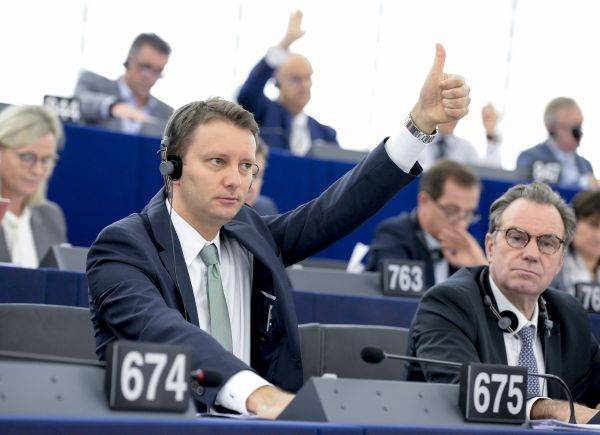
The majority of the European People's Party MEPs will not vote today on the proposal to refer the EU-Mercosur agreement for an opinion from the Court of Justice of the European Union, claims Siegfried Mureşan, vice-president of the respective political group in the European Parliament.
Siegfried Mureşan stated: "Basically, if the European Parliament were to vote to refer this agreement to the Court of Justice, so that judges could check whether the EU-Mercosur agreement complies with the provisions of the EU treaties, then the European Parliament would be raising questions about its own capacity to legislate and decide on a law. And that is why I think it would be a mistake. Members of the European Parliament have the obligation to analyze, to work on legislative proposals and to vote with knowledge of the facts. They cannot give up and abandon their obligation to legislate by referring it to the Court of Justice. It would be a weakening of Parliament, it would be a weakening of this institution. Especially now when the whole world is looking at the European Union. Other partners with whom we are negotiating free trade agreements, India being one of these partners, need to see the capacity of the European Union to act. The European Parliament would be making a mistake if it were now to shirk its responsibility to ratify the agreement with the Mercosur states and would refer it to the CJEU. We have seen on all occasions that there is a majority in the European Parliament on free trade, but now we see that there is an alliance of anti-European forces, forces that do not believe in free trade, so-called sovereignists with left-wing parliamentarians against international trade. So, the majority that existed until now is put under pressure. I think that the result of the vote will be quite close, but, I repeat, Parliament would make a mistake if it voted for referral to the CJEU. The official position of the EPP Group is not to request this opinion. We support the agreement with the Mercosur states as a result of the protection clauses for farmers. I myself, as Vice-President of the EPP Group responsible for the budget and agricultural policies, supported and worked for these safeguard clauses at the end of last year. The EPP Group considers the agreement with the Mercosur states to be a good one in this form. The position is supportive. There are also a few delegations or individual members within the group who will vote for referral to the Court, but they I am a minority. The official position of the group is to support the agreement and not to support the referral to the Court.”
He pointed out that the current position of the EPP does not contradict the fact that, over the years, the European People's Party has established itself as the defenders of farmers. Mr. Mureşan stated: "We are a party of free trade, of economic development and of farmers, of solidarity and of European unity. That is why we are a party that has supported and continues to support the European Union's cohesion policy, the common agricultural policy, but also trade policy. (...) We do not see free trade and the protection of farmers as being in opposition. Those who want to create an opposition between free trade and European agriculture do so because they want, first and foremost, to divide, to weaken the European Union. They do so because they understand that free trade with 250 million citizens from four states would ultimately make the European Union stronger. That is why we now have free trade with guaranteed support for farmers, and that is a good thing. If there were free trade without any support for farmers, then we could not support this agreement. That is why I worked within the EPP group for this support for farmers and for the safeguard mechanism.”
• European Commission proposes additional euro45 billion to support European farmers
The EPP Vice-President said that through the agreement with Mercosur, we will be able to export a lot, including cars and subassemblies, and added: "Romania is the fourth largest car producer in the Union. This agreement preserves jobs in Romania.”
However, he acknowledged that there are some risks for farmers, but noted that this is precisely why the European Commission has proposed an unprecedented safeguard mechanism.
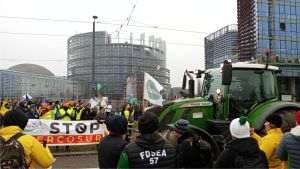
Siegfried Mureşan stated: "The European Union could react immediately by limiting trade if prices fluctuated or imports exceeded certain limits. In addition, additional support for farmers of 45 billion euros has been proposed, which is in addition to the 48 billion euros for rural development (Pillar II), obtained by the European Parliament through the negotiations that I led as chief rapporteur. The total package includes: 290 billion euros initially (Pillar I); 48 billion euros obtained through pressure from Parliament (Pillar II); 45 billion euros now proposed by the Commission; a crisis mechanism of 6 billion euros. This agreement with the Mercosur would mean more autonomy and independence for the European Union, because we would no longer depend on a particular area of the world. I understand the farmers and I was with them at the significant protest in front of the European Parliament in Strasbourg last autumn. Farmers have faced many difficulties in recent years: there was price volatility, there was uncertainty as a result of the war in Ukraine. There was pressure on them in the context of measures to combat climate change. There was additional bureaucracy. Many of these things were not directly related to the European Union, but some, for example, excessive bureaucracy, were. In addition, the European Commission proposed a draft budget for the next seven years, which was insufficient for farmers and, in addition, the agreement with the Mercosur states brought risks for farmers. For all these reasons, last summer, half a year ago, farmers had every reason to be dissatisfied, but since then things have changed. We added 48 billion euros for farmers in the budget negotiations. 45 billion have now been added in the context of the agreement with Mercosur and the European Commission has initiated two packages of debureaucratization and simplification for farmers, one of which is already in force. And as for the transition to a green economy, there too it is increasingly clear that the transition must be made with farmers, not against them and the measures on them must not put additional pressure. Measures to combat climate change and reduce pollution must not put additional pressure on farmers. As such, things have really changed. We have done a lot for farmers and I believe that farmers have reason to appreciate the significant additional support at the moment.”
The EPP Vice-President noted that it is very clear that if the agreement with Mercosur countries affects European farmers, the European Commission has a legal obligation to act. He added that it is also clear that by liberalising trade with four Latin American countries with a population of around 250 million people, there will be certain advantages for farmers, especially in the dairy sector.
"For example, it is clear that we will be able to produce more, we will be able to export more to Latin American countries. What I am trying to tell you is this: the concerns of farmers last year were legitimate. The European Union has taken them seriously and now I think farmers need to understand when they risk being instrumentalised by anti-European extremists and using farmers only to propagate their own agenda. I repeat, if the agreement with the Mercosur States will lead to risks for farmers, the European Commission has a legal obligation to act and protect farmers”, stated Siegfried Mureşan.
• CAP budget for the period 2028-2034 increased by 100 billion euros
Mr. Mureşan reiterated that the budget that farmers have guaranteed so far on the Common Agricultural Policy for the period 2028-2034 amounts to almost 390 billion euros, much higher than the budget for the current multiannual European financial year 2021-2027.
"In Romania too, the absolute amount that farmers will receive in the next seven years is higher than the amount that farmers received in the period 2021-2027 and during the negotiations we will ensure that this additional plus covers the entire inflation rate. This is the official position of the European Parliament. I repeat, when the European Commission proposed the draft budget, farmers had reason to be dissatisfied. There were 290 billion euros for them there. In the meantime, there are 390 billion euros. The difference is significant. I think farmers have much less reason to be dissatisfied now than they had half a year ago,” said the EPP Vice-President, who is also the European Parliament's negotiator for the EU budget for the period 2028-2034.
• Safeguard clauses of the EU-Mercosur agreement
He also wanted to dispel farmers' concerns regarding the monitoring of products from the Mercosur area that will enter our country. Mr. Mureşan said that the Community Executive has the obligation to act if imports increase by 5% or if the price level is affected by 5%.
"Both figures are extremely small figures. That is, the European Commission has the obligation to act on a very small movement in the market. The initial proposals when this mechanism was proposed were 10%, then reduced to 8% and now 5%. So for any small movement in the market, for any deviation, for any imports 5% above the agreed imports, the European Commission has a legal obligation to act and these are powerful instruments. As far as monitoring is concerned, it is the obligation of all those who import, it is the obligation of all those who produce to report how they produce, to report the quantities imported. It is a cooperation of the European Union institutions with national level institutions at the external border of the European Union. The legal obligations are clear and we have no reason at the moment to doubt that the European Commission would not properly implement this agreement. If we see shortcomings during implementation, we will have to react and improve implementation or monitoring”, said Siegfried Mureşan.
The EPP Vice-President wanted to mention that the agreement with Mercosur states provides for a series of transition periods, that not all provisions enter into force immediately, that there will be an adaptation period and that, consequently, he does not believe that panic regarding the agreement with Mercosur states is the right attitude.
Moreover, to dispel rumors regarding the future trade agreement that the EU is negotiating with India, Siegfried Mureşan stated that it will not include agriculture, but other economic sectors, specifying that the future agreement will have zero risk for farmers.













 Euro
Euro Dolar SUA
 Franc elveţian
 Liră sterlină
 Gram de aur





























