English

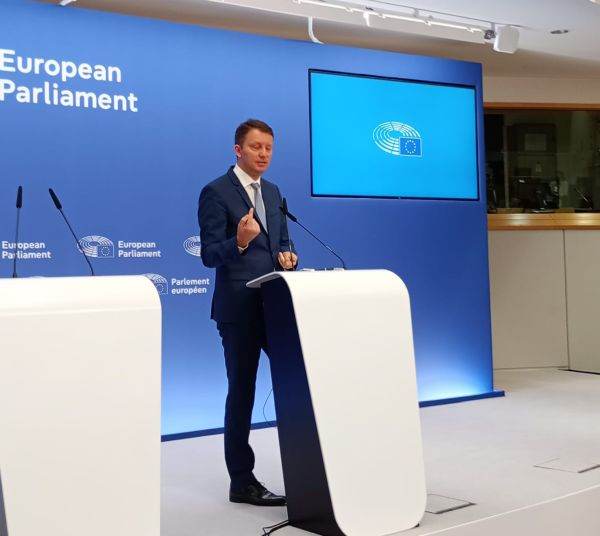
To repay the debts related to the National Recovery and Resilience Plans (NRRPs) by the EU, debts that amount to 220 billion euros, the European Parliament proposes the introduction of a digital transaction tax, said yesterday, in Brussels, MEP Siegfried Mureşan, EP co-rapporteur on the 2028-2034 multiannual budgetary framework. He explained that the method of payment for debts incurred for non-reimbursable funds must be approved by December 31, 2027, and that, currently, there is a majority in the European Parliament that supports this tax, and some governments of the member states are even actively requesting it.
Siegfried Mureşan stated: "The European Parliament's proposal is that the repayment of debts incurred for the PNRRs of the Member States should be made from the European Union's own sources of income, outside the European Union budget. For non-reimbursable funds, we need a solution, and this tax on digital transactions can be a solution. Our objective is to find a solution that generates its own sources of income and guarantees the continuation of projects with European funds without having budget cuts. It is unnatural for the world's largest digital companies, the technological giants, to have significant turnover in the European Union, to have considerable profits and not pay any taxes here. It would be unnatural for us to reduce support for European farmers, for European SMEs, for European researchers, for the modernization of hospitals or schools, at the same time that the technological giants do business and do not contribute anything to the European Union budget or to the budgets of the Member States. Therefore, one of the European Parliament's proposals will be to have a tax on digital transactions, which would constitute a direct source of income for the European Union”.
Mr. Mureşan also mentioned some technical details, as well as the application model of this tax, which already exists in several EU member states, including Austria.
"Austria is the closest example to what we would like at European level and there will probably be a minimum threshold for the turnover of companies that will be taxed, a minimum threshold for turnover at European level. It will be a tax on all digital transactions, a small share of the turnover of the respective companies. So, basically, the digital transaction tax will be a tax on the turnover of companies. We need to see exactly how such a tax is implemented; an estimate will be made by a specialized firm. We will need to see exactly how it operates, how much revenue it generates, how much profit it generates, and we will do the technical work in the coming months to see how such a tax can work in reality. (...) Any own source of revenue created by the European Union can only enter into force if it is decided unanimously by all the governments of the member states, grouped in the Council of the European Union, only if it is ratified in all the national parliaments of the member states and if it is voted on by an absolute majority in the European Parliament. The objective is to have additional own sources of revenue for the European Union on January 1, 2028,” said Siegfried Mureşan.
The MEP presented this tax on digital transactions as a viable alternative to other proposals from the European Commission that do not meet consensus. Among them is the increase in tobacco taxation, proposed by the Community Executive, a proposal about which Siegfried Mureşan said: "There is a clear position on this tobacco tax from several member states and I do not think that unanimity is feasible at the moment; that is why alternatives are needed, and digital transactions are the alternative to the tobacco tax.”
He added: "The European Commission has also proposed taxing all large corporations with a turnover of over 50 million euros. I believe that this tax will not meet the unanimity of the member states either, and that is why we need alternatives that do not affect the competitiveness of the European economy and do not burden citizens. (...) Likewise, the Commission presented several proposals last July, such as a tax on tobacco and a tax on non-recycled electronic waste, which we will have to analyze." It is certain that, through the future tax on digital transactions, the European Parliament proposes that, in the period 2028-2034, the European Union collects, in the seven years, 200 billion euros, a fairly high threshold, according to Siegfried Mureşan.

























 Euro
Euro Dolar SUA
 Franc elveţian
 Liră sterlină
 Gram de aur