English



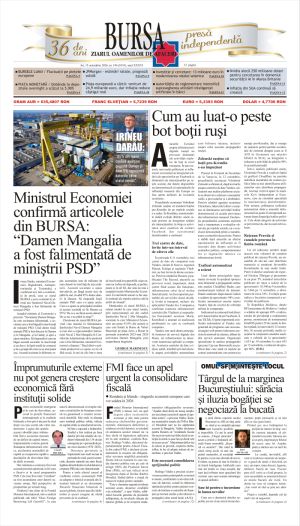
What has been happening at Fondul Proprietatea lately can no longer be described as either a procedural misunderstanding or a legitimate governance dispute. The facts, put together and officially confirmed by the fund manager himself, Franklin Templeton, through the press release published yesterday on the Bucharest Stock Exchange website, show us a deliberate scenario with a clear objective: moving decision-making control from a transparent and predictable market architecture to an informal nucleus of influence in which the state and capital market actors act in concert.
The central piece of this picture is the press release published by Franklin Templeton, a document that definitively breaks the smokescreen of the official discourse and sets the real chronology of events. Franklin Templeton explicitly states that, on January 22, 2026, negotiations for a 4-year term were concluded, with a consensus on the principles and terms of the contract. Moreover, the administrator unequivocally states that it made major material concessions, including the waiver of the early termination indemnity clause, precisely to ensure the stability of the Fund and its ability to negotiate major strategic transactions, such as the potential capitalization of the stake in the National Airports Company of Bucharest.
After the finalization of this agreement, and not before, the Board of Representatives publicly announced the launch of a new selection process for the administrator of the FP. A move that, according to Franklin Templeton, "fundamentally changed the premises” of the negotiation and nullified the logic of the concessions made. In other words, the rules were changed after the game had already been accepted by both parties. The reintroduction of the indemnity clause, limited to the first two years, was not an escalation, but a defensive reflex in a context in which the promised stability had unilaterally disappeared.
This rupture is not accidental and cannot be separated from the pressure exerted by the state, through the Ministry of Finance. Although it holds only 11.57% of the capital of Fondul Proprietatea, the Ministry of Finance intervened aggressively in the preparation of the AGM of February 26-27, 2026, demanding that the administrator's mandate be reduced from four years to a single year and promoting "immediate" revocations from the representative structures elected at the end of last year. This is not a request for adjustment, but an attempt at institutional weakening: an administrator kept for the short term is a vulnerable administrator, lacking leverage and strategic authority.
We remind you that this is not the first action of this kind by the Ministry of Finance, which over time, as we reported in the pages of the BURSA newspaper, has put pressure on private pension funds to vote at the FP in the direction desired by state representatives.

The moment chosen for this offensive is not accidental either. At the end of 2025, Fondul Proprietatea reported a net asset value of 0.7944 lei/share, while the market price was in the range of 0.67-0.68 lei, which means a discount of over 15%. This is exactly the window in which the accumulation of shares becomes not only cheap, but also extremely efficient from the perspective of future influence.
In this context, Lion Capital appears, with a move that can no longer be read as a simple investment bet. The public offering launched targets 191.6 million shares, i.e. 5.986% of Fondul Proprietatea, at a price of 0.68 lei/share, for a total value of approximately 130 million lei. However, Lion Capital is not starting from scratch. Before the offering, its direct holdings were approximately 2.38%. If the offering is completed, Lion's total stake will rise to 8.3-8.4%. For now, Lion Capital has accumulated 20% of the desired 6% by noon yesterday.
The BURSA newspaper also informed you about how Lion Capital initiated the offer for the shares of Fondul Proprietatea, given that the state expressed its intention to buy back the shares held by FP in the National Airports Company of Bucharest and the National Ports Administration Company of Constanţa at the end of last year and the beginning of 2026.


After Lion Capital completes the purchase of the desired percentage of shares from FP, the arithmetic will become impossible to ignore. The state, with 11.57%, and Lion Capital, with almost 8.4% (if it reaches this value), would together reach almost 20% of the capital of Fondul Proprietatea. In a fund with dispersed shareholders, where decisions are made through coalitions and blockages, not through absolute majorities, this threshold is more than enough to equalize or neutralize the influence of new members in the management structures and to impose a strategic direction favorable to this core.
The profile of the actors adds an additional layer of gravity. A significant part of those active today around Lion Capital and other relevant players in the market come from state structures, with direct experience in administration and consolidated institutional networks. Why are we talking about players from state structures? Because Bogdan Drăgoi, the president of Lion Capital, was Secretary of State in the Ministry of Finance between September 2006 and November 2007, during the Tăriceanu government, and later, between February 9 and April 27, 2012, he held the position of Minister of Finance in the Ungureanu government. We also recall that Bogdan Drăgoi's father, retired general Dan Drăgoi, was former Secretary of State in the Ministry of Industries in the Roman and Stolojan governments.
The market reaction was commensurate. There were episodes of accelerated price increases, of approximately 5% in just two days, trading volumes that exceeded 30 million shares in a single session, with values of over 15 million lei, well above the usual averages. Suspicions reached the ASF, which says everything about the level of tension and the fragility of trust.
In this context, the Franklin Templeton press release takes on decisive weight. The administrator does not speak vaguely about principles, but comes with figures and results: a total return of 1,340% for shares and 495% for NAV, $4.3 billion in completed transactions, $1.5 billion in foreign portfolio investments attracted and 29.2 billion lei returned to shareholders. These data do not describe a failed administrator, but one that has consistently delivered and who, precisely for that reason, becomes uncomfortable at a time when the stakes are no longer performance but control.
The overall picture is deeply worrying. The state is not trying to take over Fondul Proprietatea through a brutal, visible gesture, but through a strategy of attrition: short mandates, destabilization of governance, changing the rules after the negotiations are closed and the accumulation of shares at a discount by market actors with long-standing ties to the public apparatus. If this maneuver succeeds, Fondul Proprietatea risks losing the very reason for which it was created: that of being an independent vehicle, safe from political capture.
This is no longer a technical dispute or a contractual conflict. It is a battle for a decision, fought simultaneously on the institutional and capital market fronts. And the final stake is not a mandate or a clause, but who will keep his hand on the steering wheel of one of the most important strategic portfolios in Romania in the coming years.





















 Euro
Euro Dolar SUA
 Franc elveţian
 Liră sterlină
 Gram de aur