 English

The Romanian Constitution has placed the three powers of the state - legislative, executive and judicial - on the same level, in a balance designed to prevent the domination of one over the others. None is superior to the other, and each exercises its powers within the limits established by the Fundamental Law. In recent months, however, from the decisions, communiques and statements of the Superior Council of Magistracy, the impression has become increasingly clear that the judiciary no longer sees itself as a constitutional authority equal to the other two, but claims a special status, that of primus inter pares, supreme arbiter of public life, whose decisions, interests and positions must not only be respected, but also protected from criticism from politicians, the press or civil society. Decision no. 1348 of June 9, 2026, accompanied by the press release by which the CSM announced the existence of an "unprecedented attack" on justice, the institution's reactions during June and the events that followed in the first days of July, raise a question that no authentic democracy is allowed to avoid: are we witnessing a necessary defense of the independence of the judiciary or an attempt by a constitutional power to expand its role beyond the limits set by the Constitution itself?
The question is not at all a theoretical one. The answer begins to emerge when the events that occurred in the space of just a few weeks are put together: the CSM decision identifying politicians, publications, non-governmental organizations and public figures as opponents of justice, the challenge, even from within the judiciary, of the way in which this decision was legitimized, the unprecedented reactions of the business environment and civil society, the suspension in court of the decisions of the PNL Congress, the process through which the High Court requests the state to pay 5.2 billion lei representing the salary rights of magistrates and the controversial promotions in the highest court of the country. Viewed separately, all these episodes may seem like simple events unrelated to each other. Viewed together, however, they describe a change in attitude that deserves careful analysis, because it calls into question not the independence of the judiciary, but the way in which it understands to exercise its role in a state built on the balance of powers, not the supremacy of one of them.
• CSM and the "shame” list
And yet, the way the CSM draws up lists of its critics, the way the courts suspend the decisions of a democratically elected party in a few hours, or the way the High Court, through its own rulings, demands a billion euros from the budget, shows a power that no longer sees itself as part of a balance, but as the supreme arbiter of the other two - an arbiter that, above all, does not accept being whistled at. This very impulse to proclaim itself the supreme court, not only legally, but also morally and politically, is the common thread that connects all the episodes of the last month.
There is, moreover, a profession in Romania that never fails: that of a judge who judges himself. While the rest of the country waits for months and years for a deadline, a file, or a motivation, the judicial system has proven, in recent months, an enviable efficiency precisely when it comes to its own interests or the neutralization of the other powers of the state. It all starts on June 9, 2026, when the Section for Judges of the Supreme Court of Romania adopts Decision no. 1348/2026, a document that claims, with a solemnity worthy of a better cause, the existence of an "unprecedented attack” on the independence of the judiciary and nominates, as if it were a criminal investigation, four publications (G4Media, Recorder and others), NGOs such as Funky Citizens, Expert Forum, Declic and Corupţia Ucide, plus USR and ordinary citizens active on social networks. The central argument: the very number of articles written about the leadership of the High Court and the Supreme Court of Romania would, in itself, be proof of the existence of a hostile campaign.
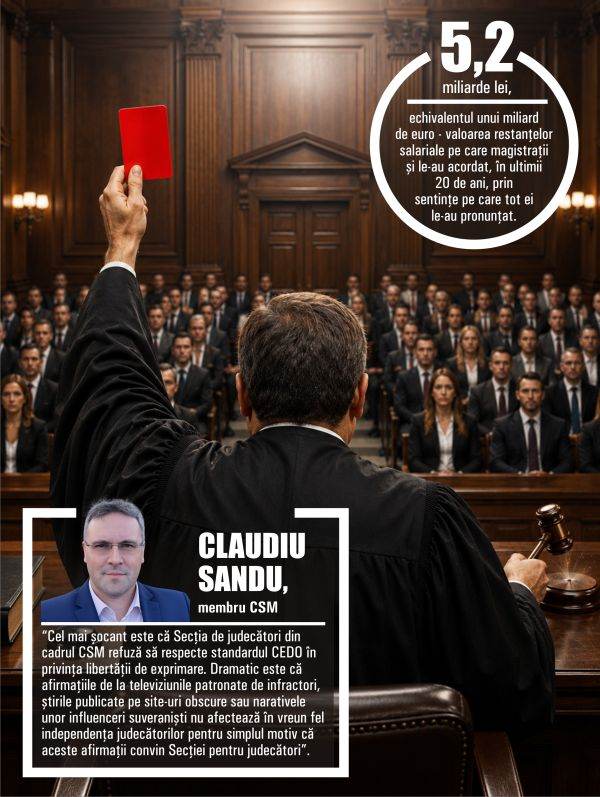
The legitimacy of this blacklist has proven, upon careful verification, to be more fragile than its authors would like. Claudiu Sandu, the ex vice-president of the Supreme Judicial Council, went public on June 11 and said bluntly that the claim that 3,580 judges would support Lia Savonea's "indictment" is a lie: his colleagues confirmed to him that, in the debate of the general assemblies, such material was not even discussed. The same conclusion came from the Romanian Judges' Forum Association, which showed that the general assemblies invoked in the document actually discussed the salaries of magistrates, not lists of targets. Sandu also drew attention to a convenient detail: the decision overlooks television stations owned by criminals and obscure websites, precisely because their narratives suit the Section for judges, while journalists who write about corruption in the judiciary, about the conveyor belt release of convicts or about how judges increase their own income through sentences suddenly become enemies of the rule of law.
• CSM, criticized by the business community
The business community, which usually prefers discretion, felt the need to break its silence. Romanian Business Leaders called the June 9 ruling "a wake-up call”, with a slogan worth remembering: "Criticizing justice means believing in it”. RBL pointed out, with figures relevant to any investor, that excessively long deadlines, delayed motivations and the lack of specialization in economic and tax litigation produce real uncertainty and recalled that, in the World Bank and World Economic Forum rankings, Romania is constantly at the bottom of the rankings in the rule of law and legal predictability chapter. The organization's conclusion was sharp: it is not the role of a judicial institution to draw up public lists of those who criticize it.
The MEPs did not remain silent either. On June 15, Vlad Voiculescu notified the European Commission, asking Commissioner Michael McGrath to include in the 2026 Rule of Law Report two episodes: the CSM decision of June 9 and the verdict of the same June 15 in the "August 10" case, in which the magistrates of the Bucharest Military Tribunal acquitted the former heads of the Romanian Gendarmerie, tried for abuse of office - intervention with tear gas and acoustic grenades - during the peaceful protests in Victoriei Square in 2018. The acquittal came exactly on the day of the 36th anniversary of the 1990 Mineriada, a detail that Voiculescu did not let go unnoticed: for those who assaulted a gendarmerie in the same context, the final convictions came in two and a half years, with execution in two cases; for state representatives accused of gassing 30,000 people, the same system took eight years to achieve acquittal. "It is not an error of the system, it is the way the system works,” the MEP summed up.
Less than three weeks after the SCM blacklist, the system also showed its face of rewards. On June 30, the SCM made public the results of the competition for promotion to the High Court. Judge Andreea Ciucă, head of the Târgu Mureş Court of Appeal and president of the Romanian Association of Magistrates, was promoted to the Civil Section. Ciucă was, in fact, a member of the Committee for the Amendment of Justice Laws, established by the Bologna Government and later abolished by the High Court itself, where, according to reports, she systematically opposed the reforms. The Criminal Section promoted judge Andrei-Cosmin Mitrache, vice president of the Craiova Court of Appeal, whose brother, lawyer Ion Bogdan Mitrache, was definitively sentenced in 2015 in two influence peddling cases, to 2 years and 6 months, and 2 years in prison, respectively, because he claimed that he could influence the judges at the Dolj Court and the Craiova Court of Appeal, citing his kinship with his brother, the magistrate. At the same time, they also promoted Judge Simona-Marina Duvalmă, from the Ploieşti Court of Appeal, and Judge Sonia Deaconescu, from the Mureş Court of Appeal, who, in 2021, publicly criticized on Facebook, without giving his name, former judge Cristi Danileţ, then excluded from the magistracy, and who, in March 2026, gave an interview in which he defended the special pensions of magistrates and criticized the documentary Recorder, which had revealed the practices of delaying cases at the Bucharest Court of Appeal until the statute of limitations had expired.
• The attack of the judiciary on the PNL
The most spectacular demonstration of this desire to arbitrate, not just to judge, came in the political sphere, where the judiciary was not content with applying the law, but practically decided who would lead a party democratically elected by hundreds of thousands of people. Amid the crisis triggered by the dismissal of the Government by a motion of censure in April, and the PNL's refusal to collaborate with the PSD, a group of about 20 "putschist" parliamentarians and local leaders challenged in court the decisions taken by the National Political Bureau (June 15), the Extraordinary National Council (June 19) and the Extraordinary National Congress (June 21), through which the Bolojan leadership reorganized the party. The first victory of the dissident camp came on June 18, at the Ilfov Court, which decided in just a few hours, without an effective defense by the party, that a party cannot impose on parliamentarians how to vote. The second success came on July 1, when the Bucharest Tribunal, in the case filed by 18 members of the dissident camp - including Monica Cristina Anisie, Alina Gorghiu, Lucian Bode, Rareş Bogdan and Adrian Veştea - suspended the effects of the June 19 decision of the Extraordinary National Council, arguing that the new "team" election mechanism, by motion, had been applied before the draft statute as allowed it to be effectively approved.
In this very context, the PNL reported, on July 1, two "suspicious incidents”. The first: just two days after the Congress of June 21, the governing board of the Bucharest Tribunal established, by Decision no. 18/23 June 2026, six specialized panels for cases concerning political parties, made up of only six judges out of a total of over one hundred, appointed directly by the president of the court - a decision that the PNL considers unprecedented, adopted without the opinion of the Supreme Court of Justice, required by law for any newly established section. The second: the file regarding the decisions of the Congress of June 21 was assigned to judge Mihaela Luciani, whom the PNL indicated had been seconded, by Decision no. 2156 of September 14, 2023, at the Ministry of Justice, at the request of Alina Gorghiu - then Minister of Justice and, later, the plaintiff in this very case. PNL requested the judge's recusal; the recusal was apparently not sufficient. On July 8, Judge Luciani pronounced the sentence: all 17 documents adopted by the Extraordinary Congress and the National Permanent Bureau of PNL were provisionally suspended, enforceable by law - including the new statute, the new leadership and the decision that the party would no longer enter into a coalition with the PSD, plus 13 dismissals from office of some presidents of county organizations. The court fully admitted the dissidents' requests and rejected everything the party invoked. With the right to appeal in just five days. The leader of the PNL, Ilie Bolojan, reacted the same evening, announcing on Facebook that the party "will respect the provisional decision”, but that it "will not give up on the decisions taken” and that "the PNL is strong again” - a dedramatization formula that the legal reality of the day did not really support.
• Justice, primus inter pares?
If the suspension of a party congress shows a judicial power willing to correct politics, the trial running in parallel shows the same power claiming, this time, a veto right over the national budget. Yesterday, a panel of the High Court heard the appeal in a case in which the supreme court, through its president, Lia Savonea, is demanding from the Bologna Government 5.2 billion lei - the equivalent of one billion euros - representing salary arrears that the magistrates have granted themselves, over the last 20 years, through sentences that they themselves have pronounced, in violation of no less than five decisions of the Constitutional Court from 2008 and 2009 (the court postponed the ruling until July 23). The amount - 4 billion lei in arrears plus 1.2 billion lei in interest and penalties - was kept secret by Savonea and only reached the press later. The merits of the case were heard at the Bucharest Court of Appeal, which ruled in favor of the High Court from the first hearing, just one month after the filing of the action - which is why this case is considered, with some resignation, the most predictable in the recent history of Romanian justice.
Taken together, all these episodes - the blacklist contested from within the Supreme Court itself, the promotion to key positions of voices loyal to the status quo, the acquittal in eight years of Gendarmerie abuses versus the conviction in two and a half years of a citizen, the special panels set up in 48 hours to decide the fate of a party, the judge with secondment ties to one of the parties, and, last but not least, the one billion euro bill that the magistrates are presenting to themselves - no longer seem like isolated accidents, but pieces of the same puzzle: a power that no longer wants to be just equal. It is difficult to find, in all this chronology, a moment when the judiciary has recognized a limit, has withdrawn from a political conflict saying that it is not its business or has requested, at least out of institutional politeness, the endorsement of the other powers for decisions that concern them. The Constitution speaks of balance; the practice of the summer of 2026 speaks of a power that sets itself up as a victim precisely when it is criticized, that finds energy and record-breaking speed when it comes to its own salaries or interests, but that lets eight years pass, an anniversary of the Mineriad and tens of thousands of people gassed for an answer and that, in the meantime, decides who leads a party and how much it costs the state to please it. Democracy defends itself with strong, equal and accountable institutions towards each other. The practice of recent months shows, rather, an institution that no longer sees itself as part of a balance, but rather as its apex, a primus inter pares that no one voted for and that the Constitution never provided for.
• Adriana Stoicescu, judge: "Romania is dead. We are the criminals"
The situation in which the state, public institutions and the Justice system in our country have reached has disappointed judge Adriana Stoicescu, who, the other day, after a new episode in which the Tate brothers publicly presented their arrogance in front of an institution in the judicial system, wrote on her Facebook page: "The madness, falsely called the State, has, since yesterday, a face and a name. The Tate brothers. We are no longer a country or a people, a society or a state. We are the Tate brothers' closet. The cellar where they go down, from time to time, to get another carafe of wine or a bottle of pălinca.
We are the annex where they keep their chickens. And the women. I don't think there is a country left in which criminals of the lowest kind can make fun of the police, prosecutors, judges, knowing, not believing, that nothing no harm will happen to them. We no longer exist, let's understand each other. Romania is just a name, a structure that once existed, under the name of a country, today a poor rag used by criminals just to clean the mud marks from their thousand-euro shoes. We have all contributed to this, big or small, people with or without books, rich or poor, young or old. We have destroyed everything that was good, that had substance and core, essence and purpose. We were and are Europeans, we will be dust in the wind. Two criminals, spearheads for the definitive destruction of the last traces of State and authority, remind us where we are: at the bottom of the abyss. Two criminals, laughing perversely and humiliating what should be the image of the Law, showing us that we are a great Nobody, hold the mirror up to us: Romania is dead. We are the criminals. The Tate brothers are just the symbol of those who dance next to the corpse of the State, waiting for the moment to bring their its own laws, of the jungle and of the mafia. Those who will remain here, apparently alive, in fact poor viable creatures, will become servants in a tribe of lawlessness. Poor country...”.























 Euro
Euro Dolar SUA
 Franc elveţian
 Liră sterlină
 Gram de aur





























