English

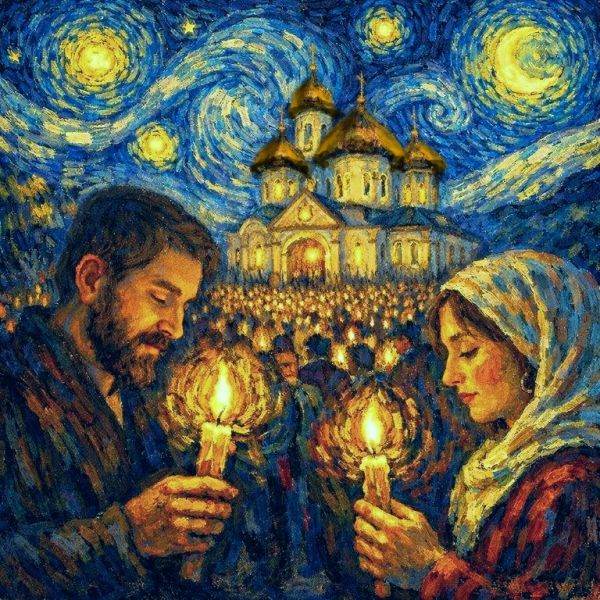

The Easter meal was not and is not just a gathering, smaller or larger, during which more or less elaborate foods are consumed. It is a silent stage on which the same play is played, year after year, with actors who change, with new and cute characters and with oppressive absences.
In the kitchens, days in advance, the fever of preparations begins. It is not just cooking, it is a ritual loaded with symbols and traditions. The eggs are carefully chosen, washed, placed neatly in pots, and the red that will dress them is not just a color, but a stubborn symbol of life that refuses to fade. The cozonac grows slowly, like a promise, and its smell insinuates itself into the walls, the curtains, the memories. The lamb sizzles discreetly, and around it gather half-told stories, repeated jokes and silences that say more than words.
The house is transformed. The dust is wiped not only from the furniture, but also from the gestures. Tablecloths that are only taken out once a year are laid, plates that have seen entire generations are lined up and everything is checked, almost obsessively, if everything is "just right". Because Easter does not accept improvisation. After a long toil and meticulous preparation, the magical moment arrives. The table is ready. On it a candle burns slowly, with a flame that trembles slightly, as if it knows that it is watching over not only those present, but also those absent. Around the table, the chairs are occupied one by one. Voices settle over the noise of cutlery, and the clinking of eggs becomes, for a few moments, the center of the universe. But there are always those chairs that remain empty. They are not left there by accident. No one moves them. No one occupies them. They are perhaps the most sincere part of the Easter table. Because they are for those who no longer come, but who never truly left. The mother who kneaded the cozonac "by eye", the father who cracked the first egg, a cousin who sometimes laughed too loudly. Now they are only in memory, but at Easter they seem closer than at any other time of the year. They are spoken about indirectly, with tenderness, with sentences that are begun and unfinished. Sometimes, someone is silent more than usual. Other times, someone smiles for no apparent reason. In reality, the table becomes a meeting place between worlds, that of the present and the hopeful future and that of memory.
The Easter table is, after all, a form of resistance. Against forgetting. Against time that breaks and separates. It is our way of saying that, despite all the departures, something remains that cannot be taken away: the ritual, the memory, the love transmitted from gesture to gesture, from one generation to another.















 Euro
Euro Dolar SUA
 Franc elveţian
 Liră sterlină
 Gram de aur