English

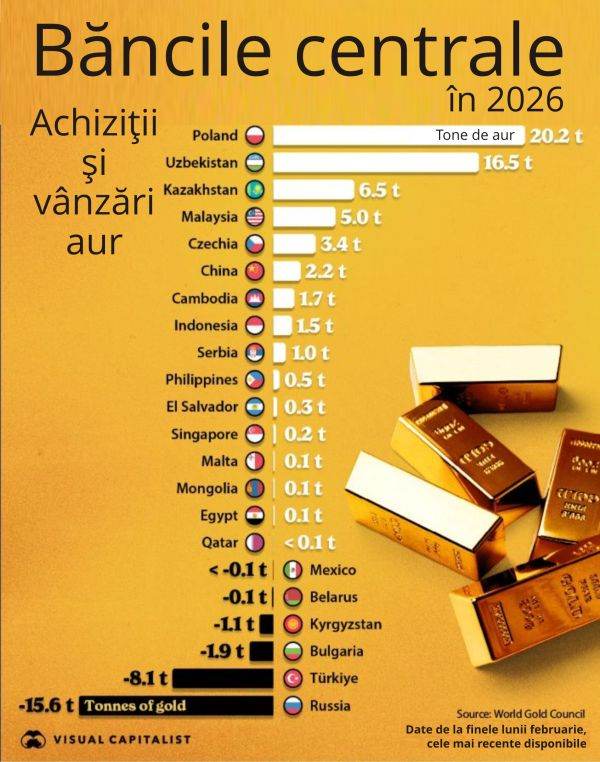
The world's central banks are following divergent paths in terms of gold reserves in 2026. While countries such as Poland, Uzbekistan and China are increasing their reserves, others, including Russia and Turkey, are selling gold to manage economic pressures, according to visualcapitalist.com. These different approaches highlight the role of gold - as a hedge (geopolitical cover) and as a source of liquidity, respectively.
The cited source presents the dynamics of central bank gold reserves, by country, at the end of February, based on data from the World Gold Council (WGC).
Poland is leading the global gold accumulation in 2026, adding more than 20 tonnes, more than any other central bank. This purchase is part of a broader multi-year plan to reach 700 tonnes, reflecting heightened security concerns on NATO's eastern flank.
Uzbekistan (+16.5 tonnes) and Kazakhstan (+6.5 tonnes) follow closely, continuing a steady trend of gold accumulation among Central Asian economies.
In 4th to 10th place in the gold acquisition rankings are the central banks of the following countries: Malaysia (+4.98 tonnes), Czech Republic (+3.36), China (+2.18), Cambodia (+1.69), Indonesia (+1.51), Serbia (+0.99 tonnes), Philippines (+0.46).
• Diversification away from dollars
The freezing of about $300 billion in Russian central bank assets in 2022 marked a turning point for global reserve management.
In response, countries such as China and several Central Asian economies have accelerated their purchases of gold, treating bullion as a reserve asset that is beyond the reach of foreign governments. Unlike foreign reserves, gold is not subject to foreign jurisdiction, making it attractive in a fragmented geopolitical landscape. Smaller buyers such as Cambodia and Serbia are gradually increasing their allocations.
• Russia and Turkey sell gold
On the other hand, Russia and Turkey are the largest net sellers of gold in 2026, according to the cited source. Russia's gold sales indicate growing fiscal pressure as wartime spending and sanctions put pressure on government finances.
At the same time, Turkey's reduction in gold sales is driven by domestic policy, including efforts to stabilize its lira and manage local gold demand.
• China and Poland - the largest gold buyers in the past five years
As the price of gold has risen massively since 2020, central banks around the world have launched one of the largest gold buying waves in modern history. According to visualcapitalist.com, the top 15 buyers have collectively increased their reserves by almost 2,000 net tons of gold between 2020 and 2025, highlighting a major shift in the official sector's strategy.
China has seen the largest increase in gold reserves during this period, adding over 350 tons. The move aligns with Beijing's long-standing efforts to diversify reserves away from the U.S. dollar and reduce exposure to Western financial systems, cementing gold's role as a politically neutral anchor in global reserves.
Poland closely follows China in the rankings, increasing its gold reserves by more than 300 tons as part of a long-term effort to bolster monetary security. Turkey and India also rank among the top buyers, adding 251.8 tons and 245.3 tons, respectively. Both countries face persistent inflationary pressures and currency volatility, making gold an attractive hedge.
Beyond the biggest buyers, several emerging markets have made notable purchases. Brazil added more than 100 tons, and Azerbaijan, through its sovereign wealth fund, more than 83 tons.
Japan, Thailand, Hungary and Singapore also added to their holdings, signaling broader global interest in gold as a safe haven during times of economic uncertainty.
At the other extreme, the Philippines saw the largest reduction in gold reserves, by over 65 tonnes. Kazakhstan and Sri Lanka also saw significant declines (-52 and -19 tonnes respectively), often reflecting domestic liquidity pressures or active rebalancing of reserves during times of economic stress.
Several European countries, including Germany and Finland, saw modest declines. Switzerland's performance was marginal (-0.1), underscoring its generally stable approach to gold management compared to other more active buyers.
Recall that last year, gold demand reached a record high as concerns about instability and trade triggered a surge in investment, even as a series of record prices kept jewelry buyers away. Global gold demand rose 1% in 2025, reaching 5,002 tonnes, the highest figure ever recorded, according to the WGC.























 Euro
Euro Dolar SUA
 Franc elveţian
 Liră sterlină
 Gram de aur