 English


The International Monetary Fund (IMF) has changed its forecasts of the global economic growth negatively, in the conditions in which the tensions between the United States and Iran have led to the increase of the costs of energy and food at the global level, informs Reuters. The forecasts were published on the occasion of the spring meetings of the International Monetary Fund and the World Bank, which are taking place this week in Washington.
The IMF announced on Tuesday that it expects the global economy to have an expansion of 3.1% this year, slower than the 3.3% estimated pace before the US and Israel started the war against Iran, on February 28. Iran has since retaliated by closing the Strait of Hormuz, a critical hub for global oil and gas supplies, and attacking energy infrastructure in the region, sending oil prices soaring and cutting oil and gas supplies, particularly hard on countries that rely heavily on these imports.
The new report also marks a slowdown from last year, when the world economy grew by 3.4%. Some regions and countries will be hit harder than others, the IMF said.
Iran's outlook, for example, saw one of the biggest revisions to the country's growth outlook: its initial modest growth forecast for 2026 was slashed by 7.2 percentage points, to a contraction of 6.1%.
The IMF also cut its GDP growth forecast for Saudi Arabia from 4.5% to 3.1%.
"The ongoing hostilities in the Middle East present immediate policy trade-offs: between combating inflation and sustaining growth, and between supporting those affected by rising costs of living and rebuilding fiscal reserves,” the IMF said in its World Economic Outlook report.
"The dynamics will be highly uneven across countries, with conflict-affected, low-income, commodity-importing countries and emerging market economies most affected,” IMF Chief Economist Pierre-Olivier Gourinchas said in a statement.
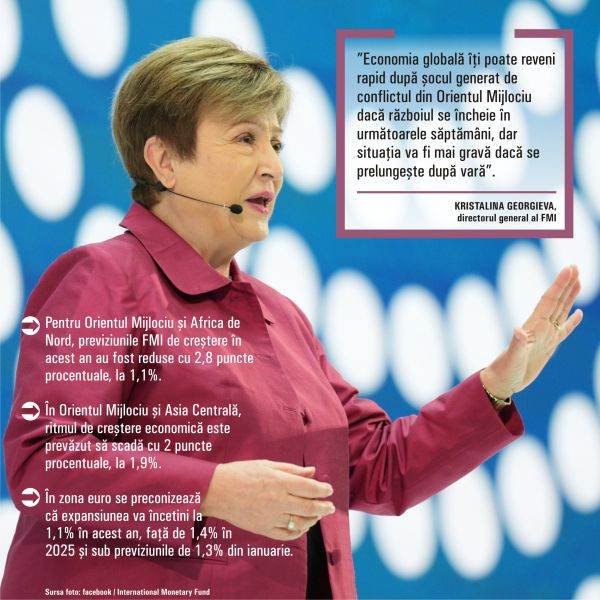
For the Middle East and North Africa, growth forecasts for 2026 have been cut by 2.8 percentage points to 1.1%. The IMF cut its 2026 forecast for the Middle East and Central Asia by 2 percentage points to 1.9%.
For the eurozone, growth is expected to slow to 1.1% this year, down from 1.4% in 2025 and below the 1.3% forecast in January.
The lower forecasts were issued amid rising oil, gas and fertilizer prices, along with a slowdown in traffic in the Strait of Hormuz, through which about 20% of the world's oil and liquefied natural gas supplies pass.
"It's just another confirmation of what we knew, which is that the war in the Middle East is changing the trajectory of growth in the short term and, if it spreads, possibly in the long term," said Aleksandar Tomic, associate dean for strategy, innovation and technology at Boston College, quoted by Al Jazeera.
• Inflationary pressures
The IMF expects global inflation to be higher at 4.4% in 2026, up 0.6 percentage points from its January forecast. The fund is monitoring the effect of a stronger U.S. dollar on inflation in developing economies because it is a typical transmission channel for tighter financial conditions in emerging markets, Gourinchas said.
Notably, the IMF has cut its U.S. growth outlook for this year to 2.3%, down just a tenth of a percentage point from January.
Experts say continued tensions in the Strait of Hormuz could worsen inflationary pressures in the coming months.
"For every $10 increase in oil prices, we should expect GDP growth to decline by about 0.4 percent. That is, a $60 increase above the average price would put the US firmly in recession territory," Babak Hafezi, a professor of international affairs at American University, told Al Jazeera.
Gasoline prices have continued to rise in the US, with the average cost of a gallon (3.78 liters) standing at $4.11, up from $2.98 on February 28, when the US and Israel attacked Iran, according to the American Automobile Association, which tracks gasoline prices daily.
But the pressure on oil prices could be easing. Oil prices fell on Tuesday on hopes that Iran would resume talks with the US to end the war.
• Forecasts revised for Romania
The International Monetary Fund has reduced its estimates for the growth of the Romanian economy this year to 0.7%, from 1.4% as forecast in October, and for 2027 an advance of 2.5% is anticipated, according to Agerpres.
After an inflation rate of 7.3% last year, the international financial institution expects this year to be 7.8%, compared to a level of 6.7% forecast in October. Next year, the inflation rate is expected to decrease to 3.9%.
In contrast, the current account deficit, which stood at 8% of GDP last year, is expected to decrease to 6.8% of GDP this year, but above the estimate of 6.6% in October. For next year, the current account deficit is estimated at 6.2% of GDP.
Regarding the unemployment rate in Romania, the IMF indicates that it will decrease from 6.1% in 2025 to 6% in 2026 and to 5.9% in 2027. In October, the international financial institution forecast an unemployment rate of 5.8% in 2026. In this context, the Minister of Economy, Irineu Darău, stated that a 0.7% growth in the Romanian economy is "a more realistic forecast" compared to the previous estimate, especially considering the external factors that our country cannot control. Asked by Euronews what scenarios Romania is making given that the IMF is warning that there is a risk of a recession for the world economy, Irineu Darău also said: "I start from the economic growth figure. It is true that that 1.4% was estimated by the IMF sometime last year. This year's budget is built around 0.91% economic growth. Perhaps now, with the fuel crisis, that 0.7% growth is perhaps a more realistic forecast. Indeed, inflation has also increased, but on the other hand, it is noticeable that for now the entire increase in fuel prices has not been transmitted throughout the entire product chain. And this is the part, I would say, of external factors. Whether, as the IMF says, we are seeing a slowdown in the global economy, or whether we are talking about the price of fuel, these are things that we cannot control."
We recall that Romania entered a technical recession, recording consecutive declines in the economy in the last two quarters of 2025.
• Ken Griffin, Citadel: "Global Recession Inevitable if Strait of Hormuz Remains Closed”
The global economy will inevitably enter a recession if the Strait of Hormuz remains closed for a long period of time, Ken Griffin, CEO of the Citadel investment fund, said on Tuesday, quoted by CNBC, according to news.ro.
"Let's assume the strait remains closed for the next six to 12 months. The world will end up in a recession. There is no way to avoid it,” Griffin said on stage at the Semafor World Economy conference, organized in Washington. According to him, such a situation would accelerate a major shift towards alternative energy sources, such as wind, solar and nuclear power.
However, the hedge fund leader believes that the effects of the war would have been worse if the United States had postponed possible military strikes until Iran's military capabilities had become stronger.
Stock markets have since managed to recover losses and return to levels seen before the US attack on Iran in February. However, investor optimism depends largely on the duration of the Middle East conflict. Many analysts believe that the risk of an escalation of tensions between the two states is not yet reflected in market prices.
Global economies, especially those in Asia, remain vulnerable to rising oil prices. Prices remain around $100 a barrel, below the peaks reached during the conflict, but well above pre-war levels, when oil traded at just under $70 a barrel.
• IEA, IMF and World Bank warn of global energy and economic shock
The impact of the Middle East war is substantial, global and highly asymmetric, disproportionately affecting energy importers, especially low-income countries, according to a joint statement issued on Monday by the International Energy Agency (IEA), the International Monetary Fund (IMF) and the World Bank (WB), reports vovworld.vn. The shock has led to rising oil, gas and fertilizer prices, triggering concerns about food security and job losses. Due to supply disruptions, shortages of key production factors are likely to have implications for energy, food and other industries, according to the cited source. The conflict has also forcibly displaced many people, affected jobs and reduced travel and tourism, and recovery will take time.























 Euro
Euro Dolar SUA
 Franc elveţian
 Liră sterlină
 Gram de aur





























