English

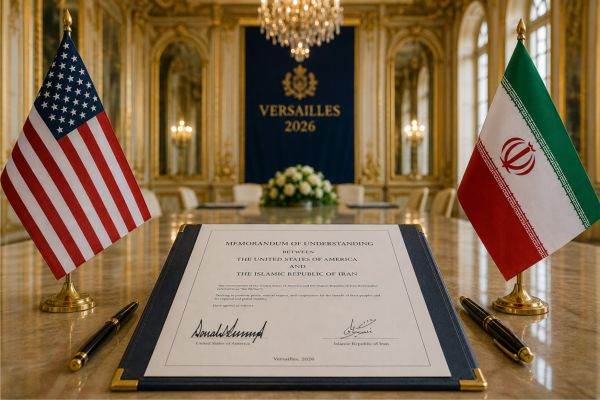
The memorandum that was to be signed today between the United States and Iran was finally initialed yesterday, after Tehran's representatives electronically signed the agreement between the two states, following the initiative of US President Donald Trump, who signed the respective document in Versailles on Wednesday evening, at the end of the G7 summit. Moreover, after signing electronically, Iranian representatives announced that they would not travel to Switzerland today for the ceremony to initial this document. However, Swiss authorities have stated, according to Reuters and the daily Al Arabyia, that the first talks between the United States and Iran, following the signing of the memorandum, are planned today in the mountain resort of Buergenstock in Switzerland.
"At this stage, the plan remains for representatives of the US and Iran, together with mediators from Pakistan and Qatar and other countries involved, to meet tomorrow in Buergenstock for initial negotiations on the implementation of the agreement. At present, no further information is available on the program and details of this meeting,” the Swiss Foreign Ministry said in a press release issued yesterday morning.
The significance of the timing and place chosen by Donald Trump to sign this agreement has gone unnoticed in the media, given that the peace treaties after the First and Second World Wars of the 20th century were signed in Versailles. Basically, Donald Trump wanted to go down in history like Theodore Roosevelt and Harry Truman, as one of the American presidents who ended a conflagration of global proportions.
The American and European media claim that the memorandum represents, beyond the cessation of hostilities, one of the most important geopolitical documents of recent years, because it does not only establish a military pause, but also redraws the balance of power in the Middle East. CNN, BBC, The Guardian, TF1, Politico, Reuters show, however, that, analyzed as a whole of the 14 points and compared with the declared objectives of both camps before the war, the document suggests that the main political and strategic beneficiary is Iran, while the Trump administration tries to present the agreement as a diplomatic victory centered on the nuclear file.
• A 60-day respite until the final agreement
The first point is perhaps the most significant. The US and Iran commit to the immediate and permanent cessation of military operations, including in Lebanon. If the initial goal of Washington and Israel was to diminish Tehran's regional influence and weaken its network of allies, the end result is the opposite: Iran is not forced to abandon its alliances, and the conflict ends with a mutual non-aggression agreement. In strategic terms, the survival of the Iranian regime and its recognition as an equal interlocutor are already a major gain for Tehran.
The second point reinforces this impression. Mutual respect for sovereignty and non-interference in internal affairs means, in effect, abandoning the American discourse on regime change in Iran. For decades, Iranian leaders have considered external pressure an existential threat. Now they are gaining explicit recognition of the legitimacy of their state.
The next point in the memorandum sets a 60-day window for negotiating a final agreement. For Iran, this means buying time and suspending military pressure at a time when its economy and infrastructure have been damaged by the war. For the US, it is just a promise that negotiations will continue.
Point four represents one of the biggest American concessions. Washington is committed to lifting the naval blockade and withdrawing its forces from near Iran after the final agreement. In return, Iran offers only the gradual resumption of maritime traffic. From a cost-benefit perspective, the American concession is much more concrete. Moreover, point five, which refers to naval traffic through the Strait of Hormuz, one of the world's most important energy routes, shows that although the US obtains the reopening of commercial traffic, Iran retains a central role in the future management of the strait, together with Oman and other Gulf states. Moreover, Iranian officials have already stated that they will charge fees for maritime services, indirectly contradicting the American objective of keeping the route permanently free and free.
• Iran's reconstruction, with the money of the Gulf states
The next point shows, according to the cited sources, that the war in the Middle East has been practically won by Iran, because the US is committed to mobilizing, together with regional partners, at least $300 billion for the reconstruction and economic development of Iran. It is difficult to find a precedent in which a country in conflict with Washington would obtain investment promises of such magnitude without accepting fundamental political changes.
Point seven represents perhaps Iran's greatest economic victory. The US commits to lifting sanctions, including primary and secondary US sanctions, and to facilitating the lifting of international restrictions. Even though implementation will depend on the final agreement, the mere inclusion of this provision in an official document marks a radical shift from Washington's years-long policy of "maximum pressure.”
It is only in point eight of the memorandum that we find the White House's main argument for claiming victory. Iran reaffirms that it will not develop nuclear weapons and accepts talks on enriched uranium. The problem is that Tehran has long maintained that it is not seeking to produce a nuclear weapon. Moreover, the wording is much more ambiguous than Washington would probably have liked. There is no explicit obligation to export enriched uranium, and Iranian officials have already made it clear that the stockpiles will not be sent out of the country. And this is confirmed by the next point of the memorandum, according to which Iran maintains its nuclear program at its current level, and the US does not introduce new sanctions or send additional forces to the region. In practice, the status quo benefits the party that already controls an advanced nuclear program, that is, Iran.
Point ten allows Iranian exports of oil and petroleum products through waivers granted by the US Treasury. For the Iranian economy, dependent on energy revenues, this is a huge breath of fresh air. For the world market, it means the return of a significant amount of oil. Point eleven goes even further, providing for the unblocking of frozen Iranian funds and assets. Again, the economic advantage is almost exclusively on the side of Iran. Washington does not receive an immediate equivalent in return.
• The final agreement, guaranteed by the UN Security Council
Point twelve establishes a mechanism for monitoring the implementation of the agreement. It is a technical provision, but an important one because it gives Iran a formal instrument through which it can complain about possible violations of American commitments. Point thirteen conditions the final negotiations on the implementation of concrete measures, including lifting the blockade and facilitating Iranian exports. Thus, Iran obtains benefits even before the final agreement is signed.
The last point of the memorandum provides for the validation of the final agreement through a binding resolution of the UN Security Council. For Tehran, this means internationalizing the guarantees and reducing the risk that a future American administration will unilaterally abandon the agreement, as happened with the 2015 nuclear agreement.
Looking at the document as a whole, the balance is relatively clear. The United States obtains three major elements: an end to the conflict, the reopening of the Strait of Hormuz, and an Iranian commitment not to develop nuclear weapons. In return, Iran obtains the cessation of military operations without being defeated, the lifting of the naval blockade, the prospect of the lifting of sanctions, the resumption of oil exports, access to frozen funds, the promise of a $300 billion reconstruction program, recognition of its sovereignty and the preservation of its conventional and ballistic capabilities outside of negotiations.
This is precisely why the reactions in the international press and even in American politics are so divided. While the Trump administration insists on the fact that it obtained nuclear guarantees and avoided a prolonged conflict, many conservative commentators believe that Washington has made disproportionate economic and strategic concessions. The statements of Iranian officials are even more revealing: Tehran is already presenting the memorandum as proof of the failure of American objectives.
If the assessment is made strictly in relation to the initial objectives of the war, the conclusion is that Iran seems to have come out on top. The regime has not been changed, the nuclear program has not been dismantled, the missile arsenal has not entered into negotiations, sanctions are to be relaxed, and the economy is given prospects of a massive recovery. The United States mainly gains regional stability and the possibility of claiming a diplomatic victory in the nuclear file. From a political, economic and strategic point of view, however, the balance of the memorandum tilts more in favor of Tehran than Washington.


















 Euro
Euro Dolar SUA
 Franc elveţian
 Liră sterlină
 Gram de aur