English

Security is not a product that is bought, but a capacity that is built with allies, institutions and industries, represents the essence of the first day of the international exhibition of military technology, armaments and equipment - Black Sea Defence and Aerospace 2026, an event that takes place in Bucharest, at Romaero Băneasa, between May 13-15 and which brings together over 550 companies from 36 countries on all continents.
Opening the event, Mircea Abrudean, President of the Senate, said: "BSDA has become a vital junction for the defense community. The global security landscape is changing rapidly and with it, the definition of defense itself. We are no longer just talking about equipment, we are talking about an integrated ecosystem of technology, intelligence and rapid response. As a NATO and EU member, Romania is not just an observer, but an active architect of the regional security environment. The protection frontier is now digital and autonomous. We are seeing record investments globally, where industry giants are redefining what is possible. The power of these giants lies in their ability to build bridges with national industries. Romania's National Strategy for the Defense Industry is our roadmap for transformation and is built on three pillars: modernization and digitalization, strategic partnerships and human capital. Let us never forget that no machine is better than the mind that designed it. Our goal is a collaborative ecosystem where small and medium-sized enterprises can thrive alongside leaders global. The role of private companies in this sector is essential; they act as engines of innovation, developing cutting-edge technologies faster than traditional public institutions. A strong private defense industry enhances national sovereignty and ensures the viability of domestic production through global trade.”
• SAFE, a necessary mechanism for developing local industrial capacity
For her part, Nicoleta Pauliuc, president of the Senate Committee on Defense, Public Order and National Security, stated: "We must become security providers through industry as well. The SAFE program is not a financial instrument. It is a European political decision that, for the first time, links money to local industrial capacity. Who produces matters. Who integrates national industry into supply chains matters. Who creates capacity, not just consumption, matters. Security is not a cost. Security is the condition without which there is no economy, education, health or freedom. And the defense industry is not just any industry. It is critical infrastructure for our freedom. We must also change the vocabulary. We are no longer talking about defense spending, we are talking about investments in security and we are talking about industrial investments. Money well spent on defense builds military capacity, jobs and industrial capacity at the same time. Romania now has the chance that our defense industry has been waiting for for generations. We have engineers, we have an industrial tradition, what we lack is scale, and SAFE is for the first time the instrument that can make that scale possible, if we firmly adhere to the minimum mandatory share of local production in each contract”.
Major General Sorin Cîrstea, State Counselor, Secretary of the Supreme Council of National Defense, conveyed the message of President Nicuşor Dan, from which we note that defense is no longer just about military capability, but also about strategic adaptability, technological superiority and industrial resilience.
"The continuous modernization of defense capabilities and the expansion of industrial cooperation demonstrate a clear commitment. We must challenge ourselves to think in a creative and unfettered way. The future depends on our ability to accelerate innovation and secure supply chains”, conveyed the Secretary of the CSAT, on behalf of the President of the country.
Mihai Jurca, Head of the Prime Minister's Chancellery, pointed out: "For us, investment in defense is not limited to the acquisition of equipment. Acquisition is only the first half of the responsibility. The second half is what remains in Romania after the equipment is delivered. Industrial capabilities, know-how transfer, qualified jobs, sustainable partnerships and operational maintenance centers - this is the red line of the Romanian Government in implementing the SAFE program. It is a political promise that we will not let get lost in the accelerated contracting schedule. (...) Security is not a product that is bought. It is a capacity that is built with allies, institutions and industries. The SAFE program offers us the opportunity to do this together. It is a historic opportunity and an obligation."
• Government objective: half of every euro spent on SAFE must be found in local production
Irineu Darău, the interim Minister of Economy, Digitalization, Entrepreneurship and Tourism, said that if we want to build authentic resilience, we must reconceptualize defense on three inseparable dimensions. The Minister of Economy stated: "The institutional dimension: the most exploited vulnerability in our collective defence is the fragmentation of our frameworks and the normative silos between the EU civil regulatory architecture and NATO operational doctrine. Interoperability is needed not only for systems, but also for processes, cultures and legal frameworks. From an economic point of view, this means treating the defence industry not as an isolated sector, but as an integrated engine of the national economy. Instruments such as SAFE follow precisely this operational logic. The technological dimension: the digital transformation has fundamentally changed the nature of the weapons we build and the threats we face. Tomorrow's weaponry is not purely kinetic. New weapon systems - from autonomous platforms and AI-guided munitions to networked command and control architectures and drone swarms - integrate artificial intelligence and IoT connectivity at their very core. However, the deeper the digital transformation, the larger the attack surface becomes. Technological resilience therefore means designing cybersecurity directly into military systems from the design stage. We must also confront the quantum threat: adversaries collect encrypted communications today to decrypt them once quantum capabilities mature. The "collect now, decrypt later” paradigm is a strategic exposure. A technological gap represents a strategic vulnerability. Nations that fall behind not only buy less capable systems, but also give up a long-term strategic position. The human capital dimension: talent in cybersecurity, AI, and data science is a strategic competition in itself. Retraining and upskilling programs are not social policies; they are investments in security. We must also invest in the cognitive domain, defending against cognitive warfare, the manipulation of public opinion, and the undermining of the trust that underpins any defense commitment. Digital literacy - the ability of citizens to critically evaluate information and maintain institutional trust under pressure - it is a security necessity”.
The official also said that every euro spent on defense through SAFE must leave at least half of its value in Romania, and the localization of production must be authentic, measurable, not just on paper.
"We demand authentic co-production - the right to own and modify the source code of the systems and the integration of Romanian companies into global chains. Offers that do not meet these criteria will not be attractive to Romania. (...) I have often heard defense described as an expense; I believe that this paradigm must be abandoned for good. Defense is an economic investment in sovereignty, in strategic autonomy and in the prosperity of future generations”, Minister Irineu Darău also said.
• New technologies, the stars of BSDA 2026
The BSDA 2026 exhibition marks the largest edition in the history of the event launched in 2007, and the event is attended by manufacturers of weapons, aerospace systems, drones, radars, C4ISR technologies and electronic warfare solutions that already define modern conflicts.
This year's edition takes place in an explosive geopolitical context. NATO countries are accelerating investments in anti-aircraft systems, autonomous drones, smart munitions and unmanned vehicles, after the harsh lessons of the Ukrainian front. It is precisely these technologies that now dominate the exhibition these days on the platform at ROMAERO. Kamikaze drones, autonomous surveillance systems and unmanned ground vehicles are the undisputed stars of BSDA 2026, a sign that the paradigm of classical warfare is changing at a much faster pace than Western military strategies anticipated before 2022.
At the exhibition, the Romanian Land Forces are displaying PIRANHA V personnel carriers, 84M infantry fighting vehicles equipped with Spike missiles, HIMARS installations, Gepard anti-aircraft systems, BAYRAKTAR drones, Cobra 2 tactical vehicles and modern radars. The demonstration is one with a strong strategic charge, as many of these systems have become symbols of modern warfare in Ukraine. In parallel, the Romanian Air Force is displaying F-16 Fighting Falcon aircraft, IAR 330 PUMA SOCAT helicopters, mobile radar systems and a Patriot system, in a demonstration that reflects the growing emphasis on air and missile defense.
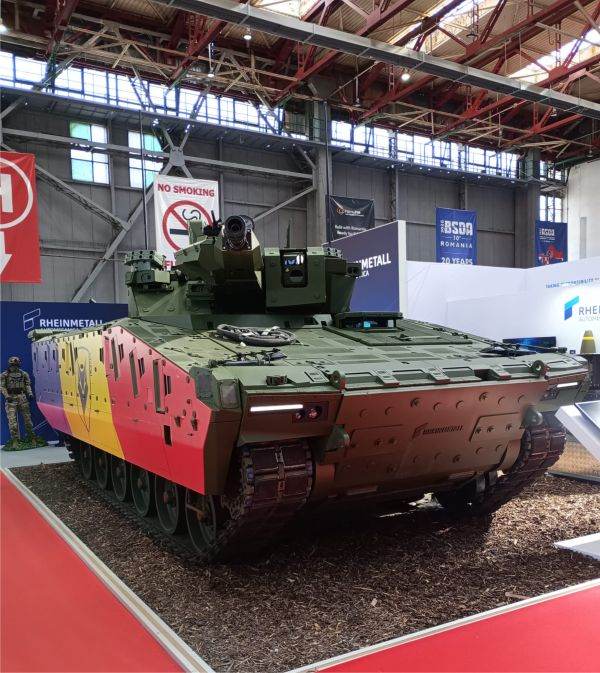
In addition to these, during the exhibition, Lockheed Martin also brought an F-35 fighter jet, which will enter the Romanian Air Force after 2030, as well as the Lynx IFV tracked combat vehicle, exhibited by Rheinmetall Automecanica Mediaş, which would be part of the Land Forces.
We note that among the strongest delegations of companies from other states are Turkey and South Korea, which present the most modern weapons and combat equipment at BSDA 2026. The event is also attended by the Turkish company ASFAT, the company that was supposed to deliver the first ship intended for the Romanian Naval Forces until now, a delivery that is delayed.
Visitors have the opportunity to see that, in our country, the defense industry is well represented in the private sector, with many small and medium-sized companies participating in the event, which offer new solutions in the optical field, in the area of special communications, but also large companies, such as Elbit Systems Romania, Elmet, Aerostar Bacău, IAR Braşov, General Dynamics Romania, Pro-Optica and even the Damen Galaţi shipyard.
Unfortunately, not all offers from private companies in Romania are taken into account by the Romanian state for equipping the armed forces, so we have found cases in which the equipment or technology they brought to BSDA 2026 is intended for foreign partners participating in this event.















 Euro
Euro Dolar SUA
 Franc elveţian
 Liră sterlină
 Gram de aur