English

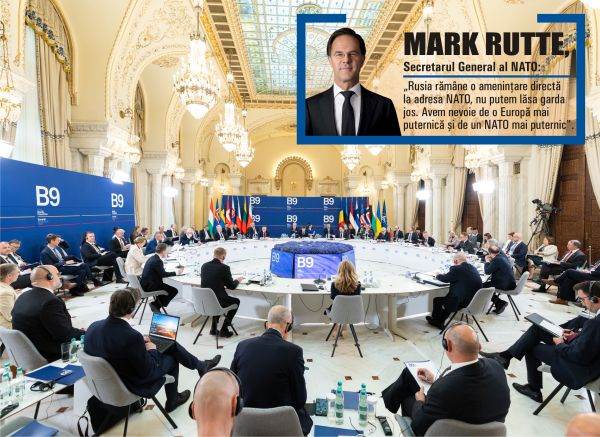
Russia is "the most significant and direct long-term threat” to Euro-Atlantic security, and the Eastern Flank states are demanding the acceleration of the Alliance's transformation into a "NATO 3.0”, built on extensive militarization, massive defense investments and a permanently strengthened military presence from the Black Sea to the Arctic Ocean, according to the final declaration of the B9 Summit, which took place yesterday at Cotroceni Palace and was also attended by the Nordic allies - Finland, Sweden, Norway and Denmark. The B9 leaders and the Nordic allies accuse Russia of "extremely conflictual actions” against NATO Allies and partners, listing sabotage, cyber attacks and "a wide range of hybrid attacks and destabilizing activities”. In a particularly harsh passage, the declaration warns that "repeated violations of airspace on the Eastern Flank underscore the urgent need to continue strengthening NATO's air and missile defenses,” including against threats posed by drones and unmanned systems.
In a press conference held after the B9 summit, President Nicuşor Dan said: "The states in the B9 Format and the Nordic area have common concerns and a common threat - Russia - and that is why it is logical that our positions be compatible through meetings such as today's. Moreover, the idea arose that this collaboration should be more formal, in a more extensive format than this. The summit declaration explicitly states that Russia is a threat to our countries.”
The country's president also said that the Republic of Moldova is threatened by a hybrid war by Russia and that it is important to support it in the face of this aggression.
In turn, the President of Poland, Karol Nawrocki, stated: "The B9 Format has been a voice of the Eastern Flank from the very beginning against the neo-imperial intentions of the Russian Federation, and we have decided to strengthen this flank. We are strong supporters of the expansion of the B9 Format with Finland, Norway and Denmark, in order to broaden the perspective of this flank from north to south, from the Arctic Ocean to the Black Sea, through the Baltic Sea. Today's declaration touched upon the increase in defense spending and a series of measures to counter threats from Russia, (...) which wants to rebuild spheres of influence, undermine NATO and weaken the security of our states."
Mark Rutte, NATO Secretary General, invited to yesterday's summit, said: "The meeting showed the commitments of allies from the North Sea to the Baltic Sea. Russia remains a direct threat to NATO, we cannot let our guard down. We need a stronger Europe and a stronger NATO. Support for Ukraine will be a priority at the Ankara summit. A stronger Ukraine is the way to stop Russian aggression. We have many friends, I hope we will have initiatives and we also need America's support for Ukraine, because Ukraine's security is our security. NATO 3.0 means a stronger NATO, but together with the US, it means a NATO both nuclear and conventional."
We note that, according to the respective document, Hungary abstained from signing this declaration, the Hungarian ambassador in Bucharest stating that his country is not in a position to support the current wording of the declaration as agreed language, a decision in this regard to be taken by the new government in Budapest.
The joint declaration is not only a new diplomatic document, but also represents a signal of strategic mobilization at a time when Europe is preparing for a long-term confrontation with the Russian Federation. The leaders of the B9 Format and the representatives of Finland, Sweden and Norway, gathered in the Capital, openly stated that the "continuous strategic line from the Black Sea to the Baltic Sea and up to the Nordic and Arctic regions” must be strengthened militarily and politically, while NATO must focus again on the "fundamental task of collective defense”.
At the heart of the declaration is the idea of an accelerated rearmament of Europe. The participating states state that they are "further increasing their contributions to collective defense” and that they are assuming "greater responsibilities through increased burden-sharing and increased defense investment,” in the context of the goal of allocating 5% of GDP to defense. The formula is extremely aggressive compared to NATO standards in recent years and shows the scale of the paradigm shift caused by the war in Ukraine and the accelerated deterioration of the European security environment. The text of the joint declaration recalls the need for a "robust advanced defense posture,” expanded military mobility, and the development of logistical infrastructure for war, including through "expanding the fuel pipelines system to the Eastern Flank”. This reference is one of the most important in the document, as it indicates large-scale logistical preparations to support high-intensity military operations in Eastern Europe.
The declaration also insists on building a Western war economy capable of sustaining a long-term confrontation with Russia. The leaders state that "further expansion of the transatlantic defense industrial base” is "essential to meet current security challenges”, and the document talks about increasing military production capacities, strengthening supply chains, multinational procurement and massive investments in military research and innovation.
We point out that yesterday's summit was also attended, as a guest, by the President of Ukraine, Volodymyr Zelensky, who said that Europe should not be afraid to discuss more united and, in some areas, more autonomous military capabilities.
"Europe cannot depend on geopolitical whims. We must unite and develop our resources, capabilities and production in Europe as much as possible, so that we truly have a common defense policy and common European defense capabilities that will strengthen both us all and alliances like NATO,” said Volodymyr Zelensky.
The Bucharest summit also marks the explicit extension of NATO's strategic interest to the Arctic. Participants welcomed the "Baltic Sentry”, "Eastern Sentry” and, especially, "Arctic Sentry” initiatives, described as "a step towards a stronger and more persistent NATO presence in the Arctic”. It is one of the clearest signals of the accelerated militarization of the North and the transformation of the Arctic into a major new space of geopolitical and military competition.
The Bucharest Summit thus confirms that the Eastern Flank has become NATO's strategic center of gravity, and the message sent by the leaders gathered in the Capital is unprecedented in its hardness, scope and implications: Europe is entering a new stage of accelerated militarization, and the strategic confrontation between NATO and Russia is already treated as a long-term structural reality.
The B9 Format (Bucharest 9) is a diplomatic and regional security initiative formed by the nine NATO member states on the Alliance's Eastern Flank. The B9 Format was established on November 4, 2015 in Bucharest, at the joint initiative of the presidents of Romania and Poland, in response to the illegal annexation of the Crimean Peninsula by the Russian Federation. The main objective of the B9 is to coordinate the geostrategic positions of the member states in order to strengthen collective defense, deter aggression on the Eastern Flank and to represent the region's specific security interests in a unified manner at NATO summits. The B9 Format includes Romania, Poland, Bulgaria, Hungary, Czech Republic, Slovakia, Estonia, Latvia and Lithuania.


















 Euro
Euro Dolar SUA
 Franc elveţian
 Liră sterlină
 Gram de aur