English


Episode 3 documented how RCEP and CPTPP create the trade architecture of the Asia-Pacific through tariff reductions and legal standards. This fourth episode introduces the third, radically different layer of the region: IPEF (Indo-Pacific Economic Framework for Prosperity).


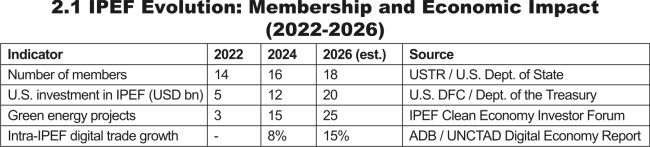
Although IPEF is not a trade bloc in the classical sense (it does not eliminate customs duties), it is included in this dossier because it represents the new model of an "economic security bloc.” In a fragmented world, alignment with strategic standards has become more valuable than tariff access, with IPEF functioning as a "trust filter” that dictates who has access to the technologies of the future. It is the mechanism through which the United States imposes the rules of the game and segments the region into "trusted” partners (IPEF members) and sources of risk (China, excluded by design).
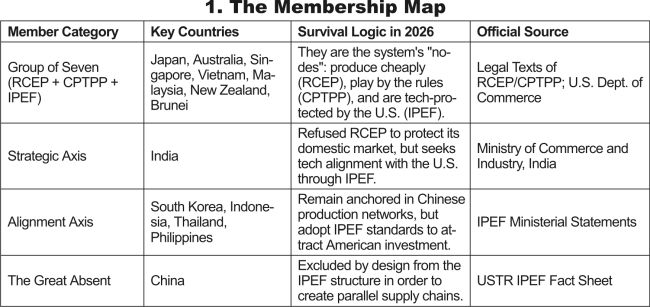
• 1. The Membership Map: The "Group of Seven” and the Great Absent
IPEF transforms regional rivalry into a complex equation of overlapping memberships, where belonging to this framework offers a "passport of trust” from the United States.
• 2. What IPEF Actually Does: The Four Pillars
Unlike 2019, in 2026 IPEF operates through mechanisms of direct economic intervention, based on interoperability rather than tariff percentages:
- Pillar I: Modern (Digital) Trade. Establishes rules for the free flow of data and artificial intelligence, countering the digital surveillance model. (Source: IPEF Pillar I Framework)
- Pillar II: Supply Chains (Security). Creates the first early warning system for crises involving semiconductors or critical minerals. (Source: IPEF Agreement on Supply Chain Resilience)
- Pillar III: Clean Economy (Energy). Facilitates U.S. investment (through the DFC) in hydrogen and solar energy, conditional upon high environmental standards. (Source: U.S. International Development Finance Corporation)
- Pillar IV: Fair Economy (Integrity). Imposes strict anti-corruption rules and fiscal discipline to secure Western investments. (Source: OECD/IPEF Anti-Corruption Guidance)
• 3. Implications for Romania
Opportunities:
- Alignment with "Trusted Tech”: Romanian IT companies (e.g., Bitdefender, UiPath) that adopt IPEF standards can access government tenders in the United States and Japan, being certified as trusted suppliers.
- Hydrogen Partnerships: IPEF funds may generate collaborations between Romanian firms and giants from Australia or Japan in green energy technologies.
Risks:
- Exclusion through Technology: The use of Chinese critical infrastructure in sensitive sectors may exclude Romania from technological benefits and associated subsidies within the IPEF ecosystem.
- Competition with Emerging Asia: IPEF states within ASEAN (Vietnam, Malaysia) are becoming preferred destinations for "friend-shoring,” competing with Romania for relocated U.S. investments.
• 4. Case Study: UiPath - Expansion Through "Trust Certification”
- Context: UiPath expanded its operations in Asia-Pacific targeting IPEF and CPTPP markets.
- Challenge: The need to demonstrate data security in the face of Chinese competition.
- Solution: Opening an innovation center in Singapore (2024) and achieving compliance with IPEF Pillar I on data flows and AI.
- Result: Regional revenues increased by 50% in 2025. UiPath became a strategic supplier for the governments of Singapore, Vietnam, and India due to its "Trusted Vendor” status.
- Source: UiPath Annual Report 2025; CSIS Asia Economic Strategy.
• 5. Practical Recommendations
- For investors: Diversify portfolios toward companies in the "Group of Seven” (e.g., Japan, Singapore) that benefit from IPEF security alignment.
- For Romanian companies: Comply with IPEF data protection standards to access U.S.-led "friend-shoring” supply chains.
- For policymakers: Negotiate technological interoperability agreements with IPEF states to facilitate Romanian software and automation exports.
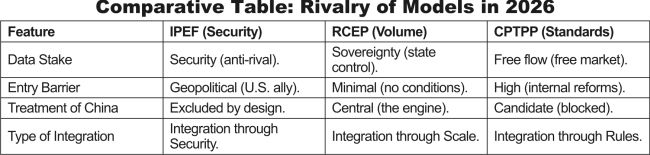
• The New Hierarchy of the Indo-Pacific
IPEF has completed the transformation of the region from a free market into a fragmented economic security space. If RCEP is the industrial "body” and CPTPP the legal "brain,” IPEF functions as a U.S.-led strategic immune system. In 2026, it is no longer sufficient to be efficient; one must also be strategically compatible in order to gain access to Western innovation.
















 Euro
Euro Dolar SUA
 Franc elveţian
 Liră sterlină
 Gram de aur