English

After four episodes dedicated to blocs operating through trade integration (USMCA, EU) or through standards and regulations (RCEP, CPTPP, IPEF), this fifth episode introduces a fundamentally different reality: BRICS+ does not compete through goods flows, but through financial architecture.
The strategic expansion from 5 to 11 members (Brazil, Russia, India, China, South Africa + Egypt, Ethiopia, Iran, Saudi Arabia, the United Arab Emirates, and later Indonesia in 2025) has transformed BRICS+ into a resource giant controlling over 42% of global oil production and covering more than 45% of the world's population.
But the decisive transformation is not only demographic, but institutional, through three pillars that offer an alternative to the Bretton Woods system:
- New Development Bank (NDB) - finances infrastructure without the political conditionalities of the International Monetary Fund.
- BRICS Payment System (mBridge) - alternative to SWIFT for settlements in national currencies.
- Contingent Reserve Arrangement (CRA) - liquidity mechanism for protection against currency pressures.
• 1. Strategic expansion: From 5 to 11 members
The most visible change compared to 2019 is critical mass. The group officially expanded on January 1, 2024, turning the bloc into a resource giant.
- Energy weight: With the inclusion of major Gulf producers, BRICS+ now controls almost half of oil production.
- Representativeness: The bloc has surpassed the G7 in terms of cumulative GDP at purchasing power parity (PPP). (Source: IMF World Economic Outlook 2025)
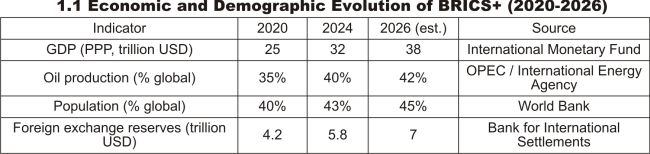
• 2. Operating mechanism: Coordination, not integration
BRICS+ is not a single market, but a coordination platform that produces specific economic instruments:
- New Development Bank (NDB): Headquartered in Shanghai, it finances infrastructure and energy projects. By 2026, it has financed projects exceeding USD 100 billion, offering an alternative to Western lending for member states.
- BRICS Bridge (mBridge): A multi-central bank digital currency project facilitating instant cross-border transactions in local currencies, reducing dependence on SWIFT and the dollar by approximately 30%.
- Contingent Reserve Arrangement (CRA): Holds over USD 200 billion to protect members against liquidity crises.
• 3. Rivalry with the "Bretton Woods” System
- The dollar challenge: The use of the yuan and local currencies in energy transactions (petro-yuan) has weakened dollar hegemony in the Global South.
- Sovereignty vs. conditionality: BRICS+ offers sovereignty-based financing, attractive to states seeking to avoid governance standards imposed by the West.
• 4. Internal limits: The fragility of a giant
- India-China rivalry: Territorial disputes and competition for leadership prevent the bloc from becoming a true economic union.
- Economic diversity: Differences between resource-based economies (Russia, Saudi Arabia) and manufacturing ones (China, India) make a common monetary policy impossible.
• 5. Implications for Romania
Opportunities:
- Gulf investments: Romania can attract capital from Saudi Arabia and the UAE (BRICS+ members) for major energy and logistics infrastructure projects (e.g., the Port of Constanţa).
- Market diversification: Romanian exports of grains and industrial equipment have significant outlets in Egypt, India, and Indonesia.
Risks:
- Dual payment systems: Romanian companies exporting outside the EU must become interoperable with the new BRICS payment standards to avoid losing market share.
• 6. Case study: OMV Petrom - ADNOC partnership (UAE)
- Context: The need to diversify strategic partnerships for offshore and green energy projects.
- Solution: Strengthening cooperation with ADNOC (United Arab Emirates - BRICS+ member) for investments in the Black Sea.
- Result: Access to massive Gulf capital and Global South trade networks, providing a strategic bridge to the bloc's energy resources, without leaving the EU regulatory framework.
• 7. Comparative Table: BRICS+ Model vs. Western Models (2026)
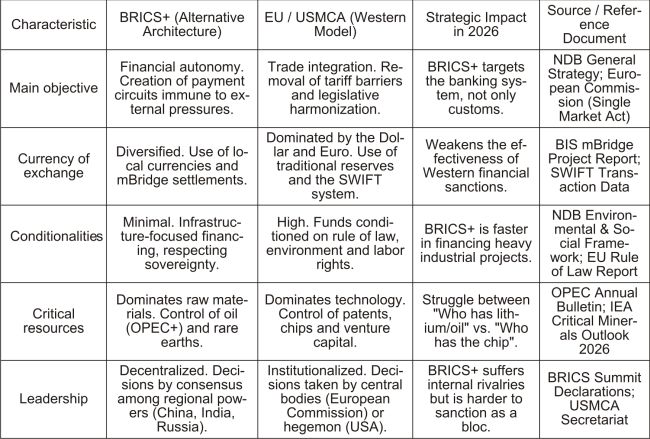
In 2026, BRICS+ has proven that globalization has bifurcated. We are no longer speaking of a single financial highway, but of two parallel systems. For Romania, the challenge is to remain anchored in the Western system while simultaneously learning how to navigate and attract capital from the new financial architecture of the Global South.


















 Euro
Euro Dolar SUA
 Franc elveţian
 Liră sterlină
 Gram de aur