English


After documenting trade fragmentation (Episodes 1-4) and financial fragmentation (Episodes 5-6), this seventh episode analyzes the third major fault line of the global economy: technological separation. Control over exports of advanced chips and manufacturing equipment has created, by February 2026, a functional economic bloc - not through a trade treaty, but through a mandatory regime of restrictions.
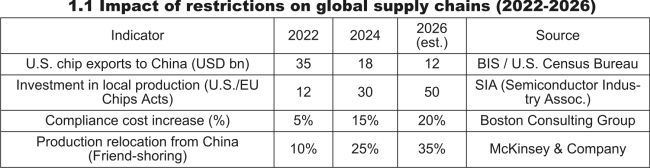
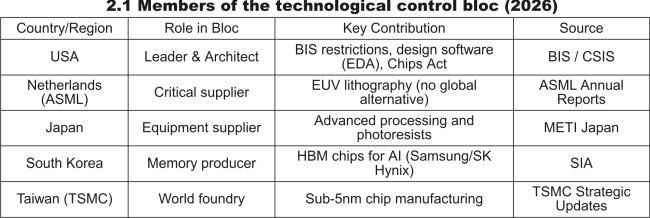
The United States established an extensive control regime under the "Small Yard, High Fence” doctrine. According to the Bureau of Industry and Security (BIS), the rules package launched in October 2022 and massively expanded through 2026 limits:
- Exports of AI and supercomputing chips;
- Exports of lithography equipment (EUV and advanced DUV);
- Provision of technical services and transfer of know-how to Chinese facilities.

• 1. Current situation: The formal regime of technological restrictions
According to the Bureau of Industry and Security (BIS) within the U.S. Department of Commerce, the rules are legal, mandatory, and extraterritorial. They have forced cascading compliance globally, since critical technologies depend on U.S. patents or software (EDA).
- Systemic effect: Firms from allied states, such as ASML (Netherlands) for lithography, Tokyo Electron (Japan) for processing, or Samsung/SK Hynix (South Korea) for high-performance memories (HBM), adjusted their deliveries to avoid violating U.S. rules (EAR - Export Administration Regulations), thereby consolidating this de facto technological bloc.
• 2. Why this is an economic bloc, not merely sanctions policy
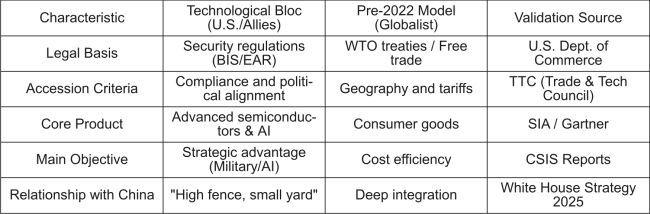
The result is the emergence of a technological space with "permitted access” and one with "blocked access.” This is the functional definition of a bloc: separation through technological compliance, not geography.
-De facto members: U.S. (Leader), Netherlands (critical equipment), Japan (materials and processing), South Korea and Taiwan (top-tier manufacturing).
- Regulatory convergence: Cooperation has been institutionalized through forums such as the Trade and Technology Council (TTC) between the U.S. and the EU, extended to Asian allies in 2025.
• 3. What did not exist in 2019: The systemic filtering regime
In 2019 there was competition, but not a systemic cross-border control regime on advanced semiconductors. After 2022, filtering became a stable regime.
Direct industrial consequences:
1.Supply chain division: ecosystems become incompatible (TSMC/Intel vs. SMIC in China).
2.Rigorous vetting: companies must verify the "end user” (Know Your Customer - KYC applied to technology).
3.Chips Acts: both the U.S. and the EU (through the European Chips Act) are injecting tens of billions to bring production "home.”
4.Slower transfer: the end of the era in which innovation circulated freely and instantly.
• 4. Implications for Romania
Opportunities:
- Funding through the EU Chips Act: Romania can attract investments in semiconductor design and packaging centers, leveraging its IT workforce.
- Security hub: strengthening its role as a regional cybersecurity leader by attracting companies avoiding industrial espionage risks in Asia.
Risks:
- Compliance costs: Romanian firms integrating hardware must invest in expensive security audits to guarantee component provenance.
- Limited access to cheap solutions: low-cost Chinese equipment (e.g., in 5G or surveillance) becomes "proscribed” in public projects, increasing investment budgets.
• 5. Case study: Bitdefender - Adapting to the "Trusted Ecosystem”
- Context: Bitdefender had to navigate U.S.-China restrictions and escalating cyber risks.
- Challenge: Maintaining global access as security technology is now viewed as an extension of national defense.
- Solution: The company strengthened its presence in strategic hubs such as Singapore (R&D center since 2023) and the U.S., aligning with "Trusted Vendor” standards. It invested in detection technologies that eliminate "backdoor” risks specific to restricted areas.
- Result: Revenues from the Asia-Pacific region (U.S. allies) increased by 40% in 2025. Bitdefender became a key supplier for critical infrastructure in Japan and Singapore, demonstrating the success of alignment with the Western technological bloc.
Source: Bitdefender Corporate Reports; Balkan Insight.
• 6. Table: Architecture of the Technological Control Bloc (2026)






















 Euro
Euro Dolar SUA
 Franc elveţian
 Liră sterlină
 Gram de aur