 English


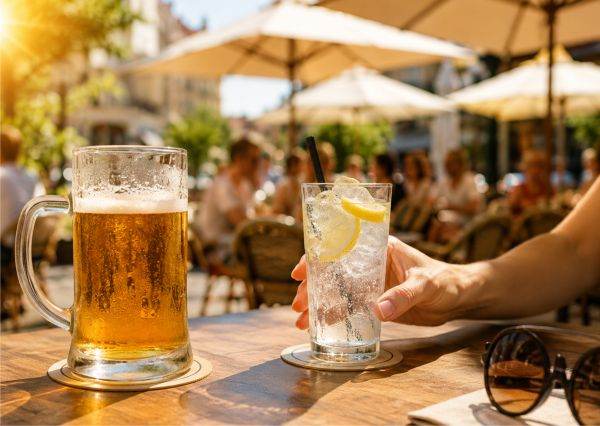
The increasingly intense heat waves affecting Europe and other regions of the world are starting to change consumer behavior and the strategies of major alcohol producers. If until recently hot summers were associated with an increase in sales of beer and other alcoholic beverages, recent studies show that extreme temperatures have the opposite effect, causing the population to consume less alcohol and turn to soft drinks or non-alcoholic options, Reuters reports.
• The positive effect of heat stops around the threshold of 32 degrees Celsius
According to a study conducted by researchers from the University of California, ETH Zurich and North Carolina State University, alcohol consumption increases with temperature only up to about 32 degrees Celsius. Beyond this threshold, the effect gradually reverses, as excessive heat reduces comfort and causes consumers to limit the consumption of alcoholic beverages. The research, based on an analysis of alcohol sales in the United States between 2006 and 2023, shows that the phenomenon is less pronounced in regions where the population is already accustomed to very high temperatures. "In general, hot weather stimulates consumption. But there is a limit, beyond which it simply becomes too hot to be comfortable,” explained Marten Lodewijks, president of the beverage market analysis company IWSR.
• Heatwave changes drinking habits
The heatwave that began in Europe on June 20 was described by specialists as the most intense recorded so far on the continent, causing thousands of additional deaths, overloading medical systems, problems in energy production and damage to infrastructure. In this context, European health authorities recommended that the population avoid alcohol consumption, warning that it promotes dehydration and contributes to an increase in body temperature. Some cities have even adopted restrictive measures. In Paris, for example, authorities have temporarily restricted the sale and consumption of alcohol in stores during the heatwave.
• Brewers are changing their portfolios
Changing consumer behaviour is also forcing major beverage companies to adapt their business strategies. Kristian Henningsen, global director of public affairs for Danish brewer Carlsberg, says there is a big difference between hot weather and extreme temperatures. "Very high temperatures make people stay indoors rather than go out for a beer,” he says. As a result, Carlsberg is expanding its range of low- and zero-alcohol beers and developing its soft drinks segment, trying to respond to new consumer preferences.
Other major brewers and spirits companies have declined to comment on the long-term impact of climate change on their business.
• Industry risk
The beverage industry used to attribute poor financial results to cold or rainy summers, but excessively high temperatures are starting to pose an equally significant challenge. A major brewer told Reuters that weather is one of the main indicators used to forecast sales and plan production. In addition to reducing alcohol consumption, the heatwave affects production costs by impacting agriculture, raw material availability and energy consumption.
Euromonitor analysts believe that the economic effects will be mixed, as extreme temperatures simultaneously influence demand, costs and the purchasing power of the population.
• Consumers are changing their preferences
The changes are also confirmed by consumer experiences. Hospitality operators are also noticing that people continue to frequent terraces and restaurants, but prefer air-conditioned premises and order iced or non-alcoholic drinks more often. Some experts believe that some consumers may react differently and drink more alcohol under the stress of climate change.
However, the general trend indicates that extreme heat waves are changing both consumer behavior and the development prospects of the beverage industry. The European Copernicus Service warns that such heatwave episodes will become more frequent and intense in the coming decades. Climatologists say that the current heatwave would have been practically impossible in the absence of global warming generated by human activity, and Europe remains the continent that is warming the fastest. In these conditions, beverage producers are forced to take into account not only the exchange consumer preferences, but also the climatic effects on the entire production and distribution chain, in a market where extreme temperatures are becoming an economic factor with a direct impact on sales.
























 Euro
Euro Dolar SUA
 Franc elveţian
 Liră sterlină
 Gram de aur





























